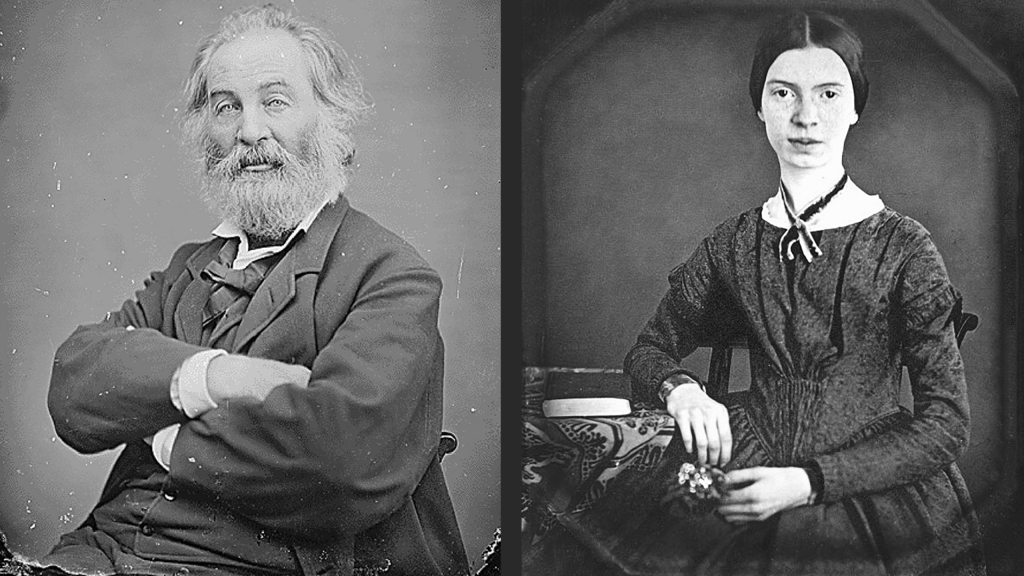
Whitman and Dickinson are frequently cast in opposition to one another: he, the master of the long line—arrogant, sexual, political, radical, self-promoting, with masculine epic reach; she, the scribbler of diminutive lyrics— reclusive, proper, death-obsessed, religious, publication-adverse, with feminine focus on flowers and birds. Such literary-biographical portraits are not without some truth or purpose, but nuanced readings of these canonical American poets suggest that the binary is neither stable nor truly representative. In fact, both poets are stylistically experimental; both answered Ralph Waldo Emerson’s call for an authentic American poet; both engage intellectually and creatively with questions about the 19th-century nation, the body and soul, religion, history, disability, science, gender, sexuality, friendship, and nature. Together they profoundly innovated American poetry and shaped the American voice in ways that extend to the present day. Indeed, from that distance they speak powerfully to us at our own moment in many ways, including Whitman’s fears and hopes for a deeply fractured nation and Dickinson’s negotiation of radical isolation.
We will make use of published collections of prose and poetry (possibly less easily separable than you think) and two online “texts,” the Walt Whitman Archive and the Emily Dickinson Archive. Because these digital archives maintain materials that might otherwise be inaccessible to us, such as facsimiles of the many editions of Whitman’s Leaves of Grass and of Dickinson’s manuscripts, they essentially preserve not only the contents or words of these writings but, in effect, their materiality and presence as historical artifacts.