
As our reading for tomorrow, and the bio you read pre-Ice Age, said, Whitman traveled to Fredericksburg from NY in 1862 when he saw his brother George Washington Whitman listed among the wounded in the absolutely brutal battle that took place under our feet. (It wasn’t that uncommon for family members to come looking for their wounded and to help care for them; in the US there was no professional nurses’ training until the 1870s.) His brother was only lightly wounded, but Whitman remained across the Rappahannock River in the Union camp for a few weeks, where what he saw inspired his new calling as a “spiritual wound-dresser.” We will read some of his impressions for our second class focused on the war and its aftermath.
In class last time, as we discussed what it means to speak and write with a specific addressee in mind, I mentioned a letter of Whitman’s that I had seen at the Library of Congress after reading its content many times in print. In this letter, he writes to assure his mother that he has located George. This is my photo:
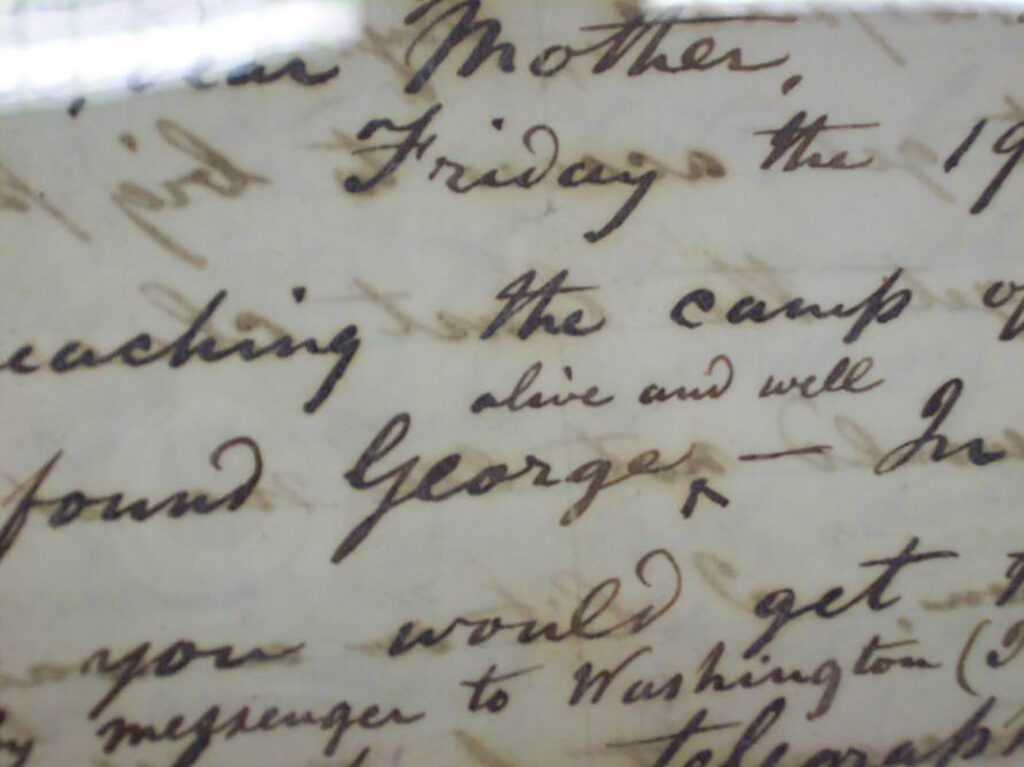
It’s the caret that breaks me.
Knowing that his mother, the addressee, would be so frantically scanning this letter to find news about her son, he returns to what he has originally written and adds quick words to comfort her. In print, there is no sense that the phrase “alive and well” is an addition, is a marker of dialogic understanding and of a son’s love. Beautiful.
I love this. It’s so human. It reaches through time and connects us to Walt even more than reading his poetry from a printed book does. I imagine him not only thinking and caring for his mother, but possibly also reflecting on the stress and worry he must have felt while traveling down to see his brother, before he understood that George was injured but okay.
So much emotion in such a simple thing.
Walt Whitman, despite being the representation and part of all things (to reference Song of Myself), has always felt pretty distanced from us (or me, at least). He is this great and talented historical figure that we often only see through his refined work. After reading “Traveling with the wounded” and seeing how he dropped everything to find his brother, and now this piece with him being attentive to his mother’s parental and human fears, I can really feel the humanity in Whitman. Perhaps more than even his poems felt (though this part could easily be up for debate).
Thank you for sharing this!