
Dear Mother

As our reading for tomorrow, and the bio you read pre-Ice Age, said, Whitman traveled to Fredericksburg from NY in 1862 when he saw his brother George Washington Whitman listed among the wounded in the absolutely brutal battle that took place under our feet. (It wasn’t that uncommon for family members to come looking for their wounded and to help care for them; in the US there was no professional nurses’ training until the 1870s.) His brother was only lightly wounded, but Whitman remained across the Rappahannock River in the Union camp for a few weeks, where what he saw inspired his new calling as a “spiritual wound-dresser.” We will read some of his impressions for our second class focused on the war and its aftermath.

In class last time, as we discussed what it means to speak and write with a specific addressee in mind, I mentioned a letter of Whitman’s that I had seen at the Library of Congress after reading its content many times in print. In this letter, he writes to assure his mother that he has located George. This is my photo:
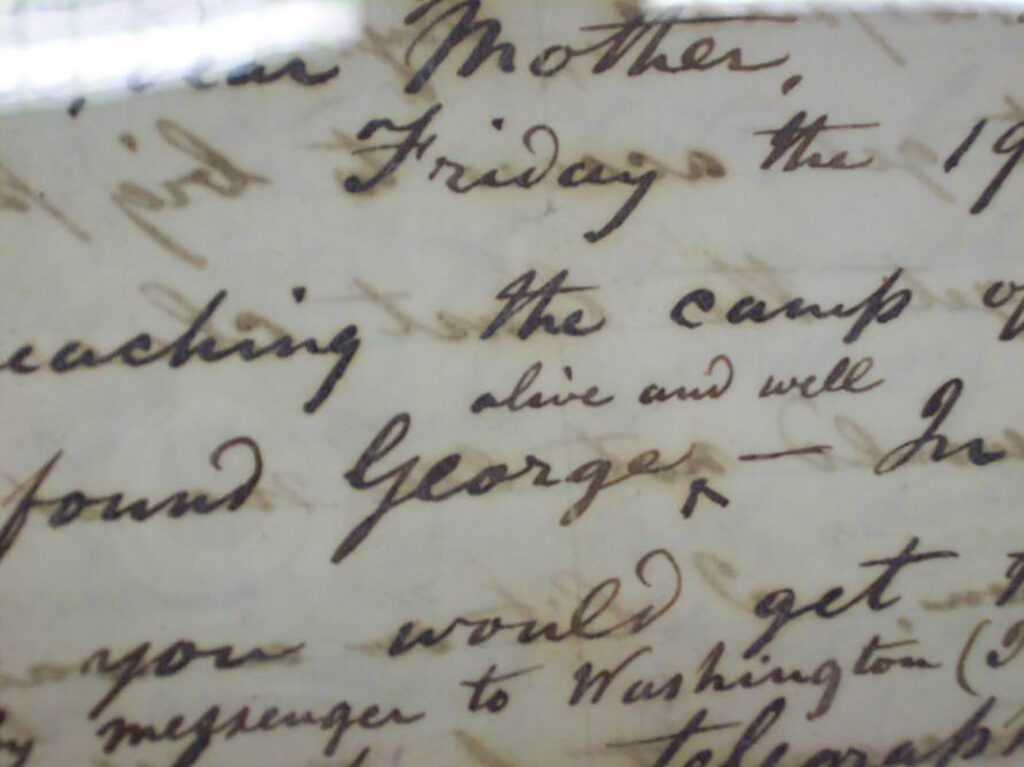
image from handwritten letter

It’s the caret that breaks me.

Knowing that his mother, the addressee, would be so frantically scanning this letter to find news about her son, he returns to what he has originally written and adds quick words to comfort her. In print, there is no sense that the phrase “alive and well” is an addition, is a marker of dialogic understanding and of a son’s love. Beautiful.

Whitman and Women: Take 2

This is my February 10th work! That said, I originally wrote this post blasting Whitman for his portrayal of women and the way he seems unable to separate them from being the vessels of life, as it were. But upon further thought, I’ve changed my mind entirely. So I deleted and I’m reposting. I’m allowed to contradict myself. I contain multitudes.

From what I gathered from Murison’s essay, she discusses the 1800s pearl-clutching in reaction to Whitman’s treatment of sexuality. Particularly his treatment of women’s sexuality, as modesty and privacy were integral to society’s definition of white women’s sexuality (which was inseparable from the heteronormative institution of marriage). Whitman, therefore, was lewd in discussing unmarried women as sexual beings. Intimacy is institutional.

Initially, I felt like Whitman played into this a bit. I focused on excerpts from “I Sing the Body Electric” where he describes women’s bodies in relation to motherhood and desire, while men were allowed to contain all the knowledge of the universe (see this post which covers what I’m talking about).

But I wanted to squash that initial reaction and give Whitman some grace. Like, alright, what was everyone else at the time writing about?

And I’ve decided that Whitman is radical in acknowledging that women have bodies at all. Bodies they should celebrate and “be not ashamed” of. In “A Woman Waits for Me,” he says:

“Without shame the man I like knows and avows the deliciousness of his sex,
Without shame the woman I like knows and avows hers.”

This right here is the open agency Whitman gives women. Whitman, in his Whitman way, throws modesty out the window. Men don’t need it, but neither do women, and that is definitely radical.