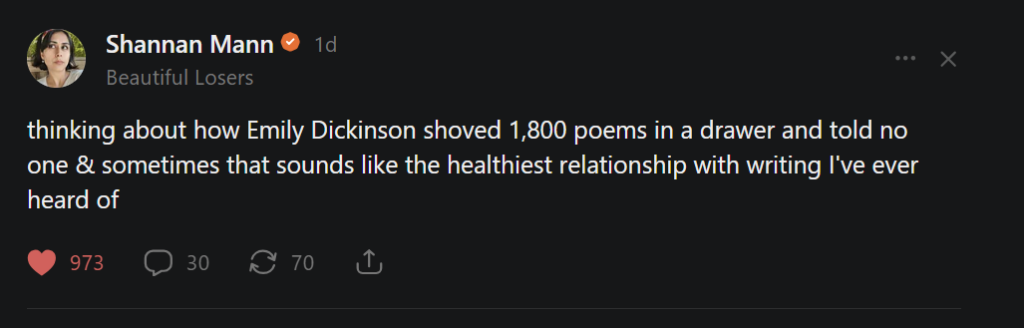
Dickinson is the first thing I see opening Substack!
1
Snow and Whitman, what more can we ask?
We’ve read two versions of “Song of Myself,” and I instantly noticed a different tone in the 1891-92 version. These lines from the opening section were seemingly added in:
My tongue, every atom of my blood, form’d from this soil, this air
Born here of parents born here from parents the same,
I, now thirty-seven years old in perfect health begin,
Hoping to cease not till death. (lines 6-9)
Here, it seems to be an older Whitman reflecting on his past self. There’s almost this conclusion that this poem started in 1855, and, although he’s about to die, this conversation existed before and will continue after him.
Because we are aware of his life story and the context he lived in, our reading is inherently altered. When I first read these lines, it set a tone of death and intrinsic sadness to the entire poem as I knew Whitman was revising this on his literal death bed.
But do you have any other interpretations of how this first section functions as a “prelude” to the rest of the poem? How did you feel initially reading this? Does this say anything about the process of a writer?
A contributor to this sadder tone is the lack of ellipses and his demure use of exclamation marks. In our class on January 22, we discussed his use of punctuation in the 1855 version, and how the ellipses provide space for both the speaker/Whitman and the reader to contemplate his points. In the “death bed” edition, Whitman omits ellipses, giving a definitive and serious voice. Part of me believes this has to do with his age and gained maturity (as a person and writer) but also because of the change in broader America. Whitman initially wrote “Song of Myself” before the Civil War, and, in this final version, the country was dealing with the effects of reconstruction and the promises of the 20th century.
Are there different ways the tone is being depicted other than punctuation? Any other parts where the tone seems extremely precise, even morbid? How do you think his experiences as a nurse contributed to his more certain tone? Are there specific parts which document America’s change?
Enjoy the snow and stay safe!
Aaliyah
Just wanted to drop in a quote said by Yusef Komunyakaa from in an interview back in 2013 (thank you, Dr. Scanlon)!
I think that what happened is that Whitman gave me a deeper hearing, which may be in concert with a deeper singing. Because I think it’s all about listening. And sometimes if we have, even accidentally, listened, we can hear an echo of the singing. I don’t think that Whitman really sets out to make sense of the world. However, we participate as listeners and readers, to make sense of Whitman. And in that sense, we are making sense of Whitman’s world. Maybe what’s most constructive, for me, is to continue to believe that there’s mystery. Whitman I think taught me to accept mystery. Everything doesn’t have to be explained. Everything doesn’t have to equal a neat number. But there is this immense mystery.
This made me think about our class today, the idea of witnessing (which Komunyakaa discusses more, especially in regards to Whitman and race), and how the act of witnessing can be a song in itself. To witness means to see, to conversate, to repeat, to answer, to reflect—all of which Whitman/the speaker and the reader are required to do in “Song of Myself.” We echo each other in both concrete and ambiguous ways.
Aaliyah
Hello!
I have a complicated history with Walt Whitman (and Emily Dickinson for that matter). A teacher in high school formerly introduced them to me, and, in lack of better words, destroyed my perception of both. He was a bad teacher for a variety of reasons, but the main thing that caused the scandal at my school was his racist micro- and macro-aggressions that more or less involved me. Drama! I know, and honestly this resulted in trauma with how I, as a Black and Asian student, function in English classes, even now.
Anyways—why did I take this class?
Well, this previous teacher of mine made me hate Whitman. I didn’t like the idea of someone speaking for all of America in the 1800s, especially in the arrogant and sweeping way he does. And we had begun the many versions of “Song of Myself” like a million times, and my teacher thought he was a Whitman-type poet and teacher himself, yada yada yada. I thought I could leave both Whitman and Dickinson behind.
But it’s hard to be a poet and not encounter both poets. I also am an American Studies double major and am interested in America’s literary history. And my hatred (if I can even call it that) towards them is too entwined with my personal educational history, I’m curious to see them in a different light.
So here I am giving it another try!
And omg I’m learning so much already!!!
In particular, the origins of Leaves of Grass (as seen on the biography page we were assigned to read). I knew some of this background but not the extent the influence of slavery had on Whitman. Then, I realized my initial uncomfortableness with Whitman back in high school may have stemmed from this:
“While most people were lining up on one side or another, Whitman placed himself in that space—sometimes violent, sometimes erotic, always volatile—between master and slave.”
My feelings towards this is complex, and I’m quite curious to read what Black scholars/writers have written on this (especially with the mentions of Langston Hughes and Yusef Komunyakaa at the end of this page).
But I view how he speaks towards a nationalistic identity during this time as both freeing and constricting. Whitman includes the working man, prostitutes, immigrants, the poor and struggling, Black slaves, and Native Americans into America’s story at a time where they are excluded. But he is also framing these people with his own assumptions of what America should be while speaking as and for everyone.
I also know I’m coming towards Whitman and Dickinson with my own bias (clearly). And I don’t live in their context. But all of these things are in my mind as we venture deeper into these literary giants. How do we define American literature or poetry? Who really is the “I” in America?
Best,
Aaliyah A. (she/her)