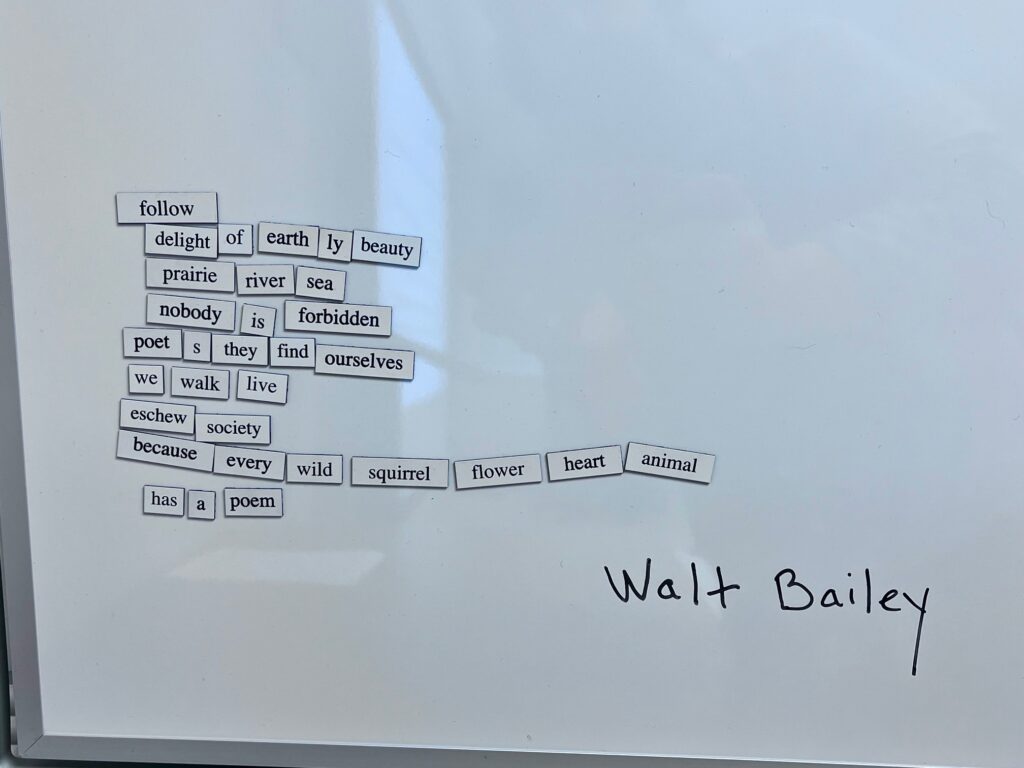
Magnetic Poetry Season Opener
1
Hello!
I have a complicated history with Walt Whitman (and Emily Dickinson for that matter). A teacher in high school formerly introduced them to me, and, in lack of better words, destroyed my perception of both. He was a bad teacher for a variety of reasons, but the main thing that caused the scandal at my school was his racist micro- and macro-aggressions that more or less involved me. Drama! I know, and honestly this resulted in trauma with how I, as a Black and Asian student, function in English classes, even now.
Anyways—why did I take this class?
Well, this previous teacher of mine made me hate Whitman. I didn’t like the idea of someone speaking for all of America in the 1800s, especially in the arrogant and sweeping way he does. And we had begun the many versions of “Song of Myself” like a million times, and my teacher thought he was a Whitman-type poet and teacher himself, yada yada yada. I thought I could leave both Whitman and Dickinson behind.
But it’s hard to be a poet and not encounter both poets. I also am an American Studies double major and am interested in America’s literary history. And my hatred (if I can even call it that) towards them is too entwined with my personal educational history, I’m curious to see them in a different light.
So here I am giving it another try!
And omg I’m learning so much already!!!
In particular, the origins of Leaves of Grass (as seen on the biography page we were assigned to read). I knew some of this background but not the extent the influence of slavery had on Whitman. Then, I realized my initial uncomfortableness with Whitman back in high school may have stemmed from this:
“While most people were lining up on one side or another, Whitman placed himself in that space—sometimes violent, sometimes erotic, always volatile—between master and slave.”
My feelings towards this is complex, and I’m quite curious to read what Black scholars/writers have written on this (especially with the mentions of Langston Hughes and Yusef Komunyakaa at the end of this page).
But I view how he speaks towards a nationalistic identity during this time as both freeing and constricting. Whitman includes the working man, prostitutes, immigrants, the poor and struggling, Black slaves, and Native Americans into America’s story at a time where they are excluded. But he is also framing these people with his own assumptions of what America should be while speaking as and for everyone.
I also know I’m coming towards Whitman and Dickinson with my own bias (clearly). And I don’t live in their context. But all of these things are in my mind as we venture deeper into these literary giants. How do we define American literature or poetry? Who really is the “I” in America?
Best,
Aaliyah A. (she/her)