Letter-poem vs. Poem-poem

I don’t know if this is controversial, but I’ve found after reading Emily Dickinson’s poetry in depth for the first time (besides the few poems in school/on Pinterest I’ve read) that I enjoy reading her letters more. Maybe I’ve gotten so used to Whitman’s long lines that I have been indoctrinated into liking longer lines more than short ones. The complex, image dense, and emotional letters make me feel like I’m “touching” Dickinson through the paper (Whitman style). Every word feels like it belongs, like every word was specially chosen after much deliberation. Yet, the words don’t feel forced. It doesn’t feel like the letters are trying too hard, or trying to be something they’re not. They’re also sooo image dense, from start to finish I am fully enthralled. It could also be the mildly taboo nature of reading someone’s personal writings. Who knows!

Electricity in the 1800s?

My work from February 10th (because apparently it failed to upload after I hit publish and I didn’t see until I went to comment something today! Don’t you love technology!)

As a science nerd one of the first things, I thought about when reading “I Sing the Body Electric” was what electric meant in the 1860s. Obviously, electricity was only just beginning to be used at this time, and it wasn’t until 1882 when the first commercial power plant was built. Whitman clearly did not have the same definition of ‘electric’ as we do today so that leads me to question what did he envision when he wrote “I Sing the Body Electric”?

If I eradicate electricity from my knowledge, the first thing that comes to mind when reading this line is lightning which inherently connects to Whitman through the theme of nature. I think it’s fair to say that Whitman was also thinking along these lines, as later on in section 5 he literally says, “I see my soul reflected in Nature”.

Throughout this poem Whitman emphasizes the connection of body and soul, saying they cannot be separated and they’re essentially the same thing expressed in different ways. I read this in 2 ways. Firstly, I can see it as encouragement to accept your own physical form and a celebration of the human body which was a radical concept during a period of conservatism and privacy. However, I can also see it as a political statement. The soul is scared, there is no question about that, but if the soul and the body are one that means that the body is also sacred. This means that all bodies should be treated with the respect the soul demands regardless of race, age, class etc. This goes back to what we’ve said many times about Whitman’s inclusivity and desire to represent all voices. In this poem he talks about “A man’s body at auction” and essentially says that even the highest bids cannot be high enough for the soul is priceless. There are many more examples of equality in this poem and I’m not going to list them all, but it is something that stood out to me as I read it for the first time.

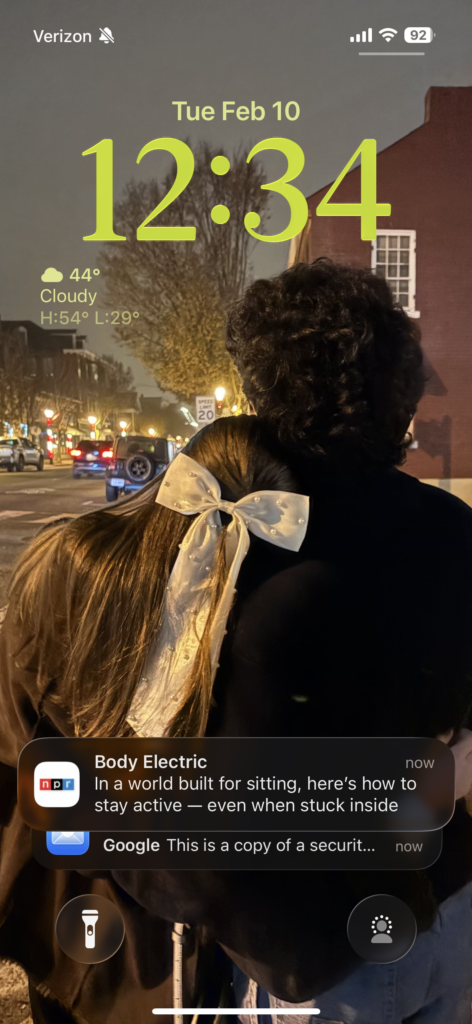
Maybe my phone is listening…maybe Whitman is listening

I got this NPR notification yesterday shortly after our class, and it got me thinking. If he were around today, would Whitman really be encouraging people to get up and work out? I don’t really think so. I think that he would be encouraging us to turn off our phones and think for ourselves instead.

Run Forrest Run *in Alabama accent*

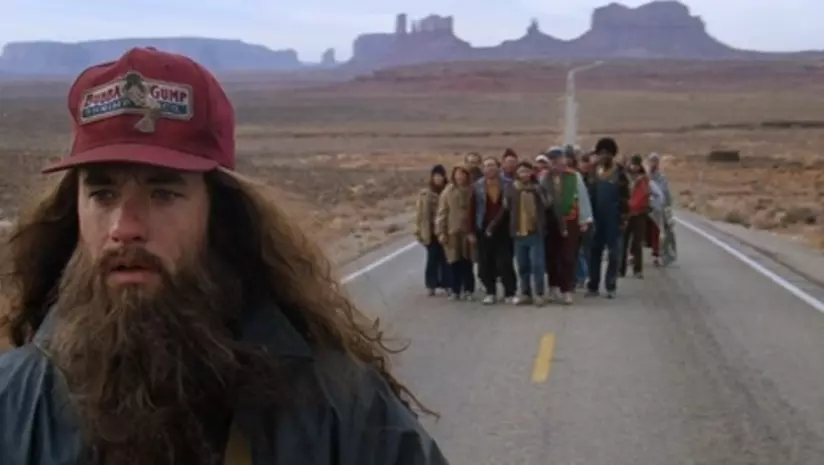
This is super random, but this thought came to me as I was re-reading “Song of the Open Road”. It honestly reminds me a lot of Forrest Gump (W movie, if you haven’t seen it, you should). Bear with me on this one. While the story is about a lot more than just running, it’s kind of Forrest’s primary thing he’s known for. He leaves everything and spends 3 years running across the country for no reason, with no destination in mind. He’s just running. Remind you of anything? Perhaps Whitman’s own journey on the open road to find himself? Whitman invites everyone to join him on his travels, encouraging them to drop everything, and take to the road much like Forrest, though Forrest does so unintentionally. This scene in particular makes me think of Whitman leading the people on his “long brown path”.

Obviously, there are many differences between the two men, considering Forrest Gump has an IQ of 75 and Whitman is, well, Whitman, but I thought it was a fun comparison and wanted to share. If you’re interested to see the part of the movie I’m referencing, I’ll put a youtube link below!

Forrest Gump runs across America for 1170 days and 16 hours

Camerado

At the end of class we were discussing what Whitman meant by the address “Camerado” at the end of his poem Song of the Open Road. This word felt like a reward of sorts. I say reward in relation to the readers of the the poem, “Camerado” feels like a compliment to those who have finished reading Song of the Open Road-they are now considered comrades. With these comrades, Whitman holds out his hand to allow those to join him in finding wonder/beauty in everything.

Oh, and this one….

Is your analysis of Whitman as a commercial agent changed by the fact that this is a luxury vehicle rather than jeans? As in my prior post (people, seriously, this is turning into Blog of Myself, you have to get on it), what does this commercial say about America? About masculinity? About freedom? Feel free to analyze any specific moments also.

Walt Whitman, Idealism, and Capitalism Walk into a Bar

These ads appeared roughly 15 years ago, and when you’ve done your (excessive, sorry [kind of]) homework for Tuesday, you’ll recognize the first voice. As we consider Whitman’s America, and circa 2010 America, and 2026 America, I invite you to analyze these videos. Is this a portrait of America WW would have recognized? embraced? rejected? Why? Would it matter to Whitman, or does it matter to you, that the poetry, and the Whitmanish slogan, were mobilized to sell jeans (by a massive company worth billions, founded by a German Jewish immigrant that began making jeans for working men during Whitman’s lifetime)? For that matter, is this an America YOU recognize? If the ads are trying to sell both jeans AND a vision of America, what do you make of that vision?

Elisabeth’s CS for January 20th

Hello, Whitmaniacs! Having emerged relatively unscathed from our first encounter with Mister Whitman, here are some general conversation contributions:

Having read two reviews of Whitman’s work, one utterly scathing and one glowing, and then reading Whitman’s poetry right after, I’m inclined to say that neither review is entirely correct because while Whitman’s poetry isn’t my favorite, I don’t count it as unreadable. It’s just sort of there. Do you think either of these reviews are accurate and in what ways? Do you think the identities of the authors, one a man and the other a woman, have anything to do with how Whitman’s work revolted/appealed to them?

(May I just say the paragraph “…it is impossible to imagine how any man’s fancy could have conceived such a mass of stupid filth, unless he were possessed of the soul of a sentimental donkey that had died of disappointed love. This poet (?) without wit, but with a certain vagrant wildness, just serves to show the energy which natural imbecility is occasionally capable of under strong excitement” is absolutely hysterical.)

Whitman (very…very liberally…) uses the free verse to its fullest potential. He repeats beginning words or phrases often, follows no particular rhyme scheme, and his line sequences seldom follow a pattern, if ever. I think it’s interesting that his poems deal so much with freedom and the style itself is called free verse. He speaks of everyone from every walk of life, even unto death which he still hails as some sort of freedom. What is your take away from that? Is there something about his conversational style of poetry and free verse that sounds distinctly “American” in tone to you? (To me it kind of does, and not in a derogatory sense.) Or on the other hand is it just patriotic delusion?

And lastly, how do you think it is that Walt Whitman is able to connect so easily with everyone and everything in his poems, particularly Song of the Open Road? Is it his identity? Love for his country? His poems are broad and sweeping, and it’s almost like he’s a conductor and everyone on the open road is some sort of symphony but then he’s also part of that symphony. Does that make sense? I’m especially curious to know what you guys think of this in particular!