
“A Wife– at Day Break” variants

Like me, you can’t stop thinking about this. I went first to my 3-volume Franklin variorum and then to the archive.

Probably in the spring of1861, ED wrote the first version of this poem on the back of an abandoned letter, which you can see here (scroll down to see text if the manuscript doesn’t show– it was glitching of course). It uses the word Master, but also has an entirely different penultimate line, “The Vision flutters in the door -,” and doesn’t have a stanza break. But the manuscript shows that the “Vision” line was canceled out for the one with “Eternity” we have in our book. There are some dash differences to the version in the Reading Edition also.

In 1862, according the variorum, she wrote another version, and this is marked F185B and is the version that Johnson chose, his poem J461. This version adds a stanza division and changes the word “Master” to “Savior,” also using an exclamation point at the end: “Savior – I’ve seen the face – before!”

Franklin believes this poem was added to a fascicle, ED’s privately rendered books, in the second half of 1863. In this copy, his F185C which matches our Reading Edition, we have a return to the word “Master” and the dashes as we discussed them today. It makes sense to me that the version in the fascicle would be the one he used when he created the Reading Edition without variants visible, because the fascicles are seen as final copies.

This clears up the history and variants, but not necessarily the way the alternative line is a ghostly presence in the poem.

ALSO: Simpson Library has our Reading Edition available online. (Thanks, Audrey!) I’m sorry I didn’t know this before. Please use this edition to complete our assigned readings.
Ainsley’s CS for 3/24 Readings

In Martha Nell Smith’s Editorial History I: Beginnings to 1955, she says, “every writer is her first editor,” and goes on to mention how this idea elicits “special consideration” in Emily Dickinson’s case (272). I find this so interesting, on several accounts. We know from reading her letters to T.W. Higginson that she reached out to him seemingly searching for mentorship. He gave her poetic advice that she did not accept (rightfully so!). This leads me to my first (set of) question(s) connected to the quote I pulled–Could Dickinson have wanted to be her first (and only) editor? Why might she have reached out for advice? We know that she never explicitly asked for his advice (it’s just what seems most likely). If she wasn’t asking for feedback, what could she have been searching for? Additionally, the only editing feedback that Dickinson ever implemented was Susan’s advice for poem 124 “Safe in their Alabaster Chambers”. What does this say to you? I find it hard to ignore when thinking about Dickinson’s disapproval with the editing of her poems more generally, too. From what she said in her letter to Higginson about the editing of her work that was published in The Springfield Republican, her frustrations lie in the feeling of edits undermining the nature of the poem. I think that this speaks to how deeply she felt for Sue, beyond the obvious.

Smith also talks about how Sue’s process of assembling the “Book of Emily” was a slow one, partly due to her qualms with categorizing works that she did not believe could be categorized (because of Dickinson’s creative genius, and Sue’s deep affection for her creative genius) and partly due to her working during a time of immense grief. Vinnie was impatient with the speed, or lack thereof, in which Sue was working, so Vinnie discouraged Sue from continuing the project and sought other sources who might complete it faster. I don’t have a sister, and this could very well be Vinnie feeling protective over her sister in a time of grief, but I struggle not to feel a little bit critical over Vinnie in this–especially considering Dickinson not being keen on publishing her own work anyhow. Dickinson was such an appreciator of nature and its processes, and I feel that she would have appreciated Sue taking her time to work through her grief and to consider her qualms with the project. How do you feel about Vinnie’s impatience during this time? Where do you feel this impatience may have stemmed from?

The last lines of poems 5 and 7 stuck out to me immediately. Poem 5 is an assertion of love for Sue which ends in “Sue – forevermore!” Poem 7 rejoices in an everlasting summer that lives inside and ends in “Thy flower – forevermore!” The connection between the two is syntactically obvious, but I am curious about your thoughts about the connection between the two on a deeper level. Could Dickinson be aligning Sue with the summer and the bloom, vice versa, or something else? I really love these parallels and would love to hear your thoughts on them.

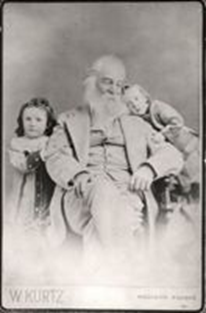
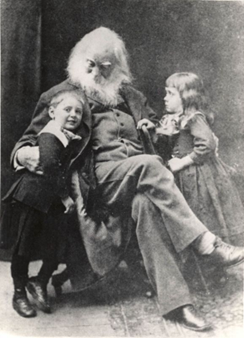
Whitman and Children

So my archive project has to do with a lot of the photography of Walt Whitman, and I think some of my very favorite photos of Whitman are those of him taken with children. So often there’s the assumption that people in the 19th century were incredibly stern and unsmiling simply because of how long and still you had to sit to get a photo taken. But these photos of Whitman with children are truly so endearing, and I wanted to share them with you all!

This photo was taken with the children of a friend of Whitman’s who housed him for long periodical stays in New York. Whitman also said he would sometimes go for walks with the children when he stayed there which is so sweet.

This photo is of Whitman with the niece and nephew of a friend, Jeannette Gilder.

Anyways, I just really liked how tender and fond he seemed of children and how much expression is found in these photos.

The ethics of representation

As promised in class, I am opening this topic for discussion since we didn’t get to it today. I think there are many ways that this connects to (but is not the same as) Whitman’s model of selfhood, which some of you may be writing about through the prompt in Response #1. The basic question might be phrased something like this: when Whitman represents, includes, or speaks for others, does he do so ethically and in a way that respects their otherness from him (in identity and experience)? I think we also want to think through what might be our contemporary understanding of that question as well as what it might have meant in his own historical moment.

A few passages in which we might ground discussion. Feel free to add more.

Section 24, page 211, the two stanzas beginning “Through me many long dumb voices”

Section 33 following the long catalog, starting page 224 with “I am a free companion” and continuing through the rest of section on 226.

Aaliyah’s CS for January 27

Snow and Whitman, what more can we ask? 

We’ve read two versions of “Song of Myself,” and I instantly noticed a different tone in the 1891-92 version. These lines from the opening section were seemingly added in: 

My tongue, every atom of my blood, form’d from this soil, this air  

Born here of parents born here from parents the same,  

I, now thirty-seven years old in perfect health begin,  

Hoping to cease not till death. (lines 6-9) 

Here, it seems to be an older Whitman reflecting on his past self. There’s almost this conclusion that this poem started in 1855, and, although he’s about to die, this conversation existed before and will continue after him.  

Because we are aware of his life story and the context he lived in, our reading is inherently altered. When I first read these lines, it set a tone of death and intrinsic sadness to the entire poem as I knew Whitman was revising this on his literal death bed.  

But do you have any other interpretations of how this first section functions as a “prelude” to the rest of the poem? How did you feel initially reading this? Does this say anything about the process of a writer? 

A contributor to this sadder tone is the lack of ellipses and his demure use of exclamation marks. In our class on January 22, we discussed his use of punctuation in the 1855 version, and how the ellipses provide space for both the speaker/Whitman and the reader to contemplate his points. In the “death bed” edition, Whitman omits ellipses, giving a definitive and serious voice. Part of me believes this has to do with his age and gained maturity (as a person and writer) but also because of the change in broader America. Whitman initially wrote “Song of Myself” before the Civil War, and, in this final version, the country was dealing with the effects of reconstruction and the promises of the 20th century. 

Are there different ways the tone is being depicted other than punctuation? Any other parts where the tone seems extremely precise, even morbid? How do you think his experiences as a nurse contributed to his more certain tone? Are there specific parts which document America’s change? 
 

Enjoy the snow and stay safe! 

Aaliyah 

Walt Witness

Just wanted to drop in a quote said by Yusef Komunyakaa from in an interview back in 2013 (thank you, Dr. Scanlon)!

I think that what happened is that Whitman gave me a deeper hearing, which may be in concert with a deeper singing. Because I think it’s all about listening. And sometimes if we have, even accidentally, listened, we can hear an echo of the singing. I don’t think that Whitman really sets out to make sense of the world. However, we participate as listeners and readers, to make sense of Whitman. And in that sense, we are making sense of Whitman’s world. Maybe what’s most constructive, for me, is to continue to believe that there’s mystery. Whitman I think taught me to accept mystery. Everything doesn’t have to be explained. Everything doesn’t have to equal a neat number. But there is this immense mystery.

This made me think about our class today, the idea of witnessing (which Komunyakaa discusses more, especially in regards to Whitman and race), and how the act of witnessing can be a song in itself. To witness means to see, to conversate, to repeat, to answer, to reflect—all of which Whitman/the speaker and the reader are required to do in “Song of Myself.” We echo each other in both concrete and ambiguous ways.

Aaliyah

American Identity in Leaves of Grass (Plus Aaliyah’s History with Walt)

Hello!

I have a complicated history with Walt Whitman (and Emily Dickinson for that matter). A teacher in high school formerly introduced them to me, and, in lack of better words, destroyed my perception of both. He was a bad teacher for a variety of reasons, but the main thing that caused the scandal at my school was his racist micro- and macro-aggressions that more or less involved me. Drama! I know, and honestly this resulted in trauma with how I, as a Black and Asian student, function in English classes, even now.

Anyways—why did I take this class?

Well, this previous teacher of mine made me hate Whitman. I didn’t like the idea of someone speaking for all of America in the 1800s, especially in the arrogant and sweeping way he does. And we had begun the many versions of “Song of Myself” like a million times, and my teacher thought he was a Whitman-type poet and teacher himself, yada yada yada. I thought I could leave both Whitman and Dickinson behind.

But it’s hard to be a poet and not encounter both poets. I also am an American Studies double major and am interested in America’s literary history. And my hatred (if I can even call it that) towards them is too entwined with my personal educational history, I’m curious to see them in a different light.

So here I am giving it another try!

And omg I’m learning so much already!!!

In particular, the origins of Leaves of Grass (as seen on the biography page we were assigned to read). I knew some of this background but not the extent the influence of slavery had on Whitman. Then, I realized my initial uncomfortableness with Whitman back in high school may have stemmed from this:

“While most people were lining up on one side or another, Whitman placed himself in that space—sometimes violent, sometimes erotic, always volatile—between master and slave.”

My feelings towards this is complex, and I’m quite curious to read what Black scholars/writers have written on this (especially with the mentions of Langston Hughes and Yusef Komunyakaa at the end of this page).

But I view how he speaks towards a nationalistic identity during this time as both freeing and constricting. Whitman includes the working man, prostitutes, immigrants, the poor and struggling, Black slaves, and Native Americans into America’s story at a time where they are excluded. But he is also framing these people with his own assumptions of what America should be while speaking as and for everyone.

I also know I’m coming towards Whitman and Dickinson with my own bias (clearly). And I don’t live in their context. But all of these things are in my mind as we venture deeper into these literary giants. How do we define American literature or poetry? Who really is the “I” in America?

Best,

Aaliyah A. (she/her)

Walt Whitman, Idealism, and Capitalism Walk into a Bar

These ads appeared roughly 15 years ago, and when you’ve done your (excessive, sorry [kind of]) homework for Tuesday, you’ll recognize the first voice. As we consider Whitman’s America, and circa 2010 America, and 2026 America, I invite you to analyze these videos. Is this a portrait of America WW would have recognized? embraced? rejected? Why? Would it matter to Whitman, or does it matter to you, that the poetry, and the Whitmanish slogan, were mobilized to sell jeans (by a massive company worth billions, founded by a German Jewish immigrant that began making jeans for working men during Whitman’s lifetime)? For that matter, is this an America YOU recognize? If the ads are trying to sell both jeans AND a vision of America, what do you make of that vision?

Will You Give Me Your Hand? Will You Come Travel With Me?

Both Walt Whitman and Emily Dickinson believed in the written word not just as an articulation of one’s inner thoughts but, fundamentally, as a way to reach and even touch other people. They lived in an era that saw the nation fracture and turn on itself, massacring its own sons; that adhered to strict classes and saw both the bitter defense of, and legal end to, the abhorrent practice of slavery but not racial oppression; that saw massive national movements of Christian revival when they themselves often met the divine in other ways; that saw Oscar Wilde in England jailed and destroyed by a sexuality the world knew how to punish but not name; that felt the national growing pains of hundreds of thousands of (mostly European) immigrants and a colonization and settlement of western territories; that did not yet offer universal public education to its children. The word–a touch–was a form of connection in a rapidly changing world. And so it shall be for us. Get at it.