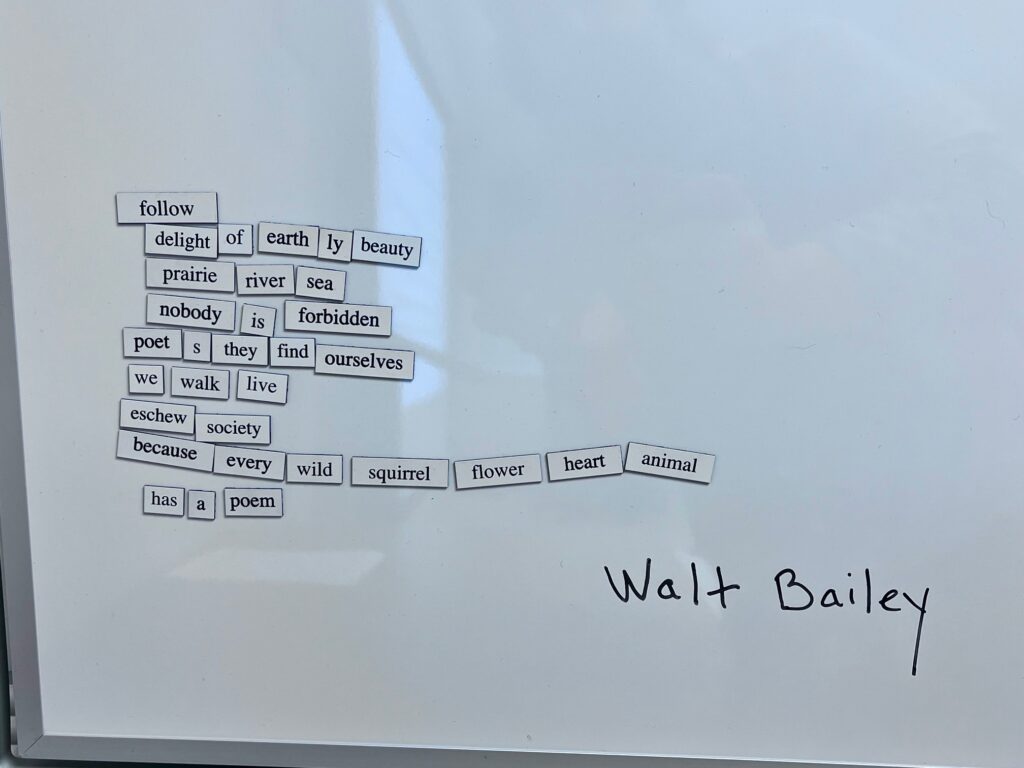
Here’s another hard right turn. Think
Of how Walt Whitman loved this country,
Loved the President who died. Imagined
Himself as a hand brushing a fly from the brow
Of a sleeping child. In the dark
I thought of a radiant ordinariness
That burned, that burned and burned.
Author Archives: mns
The ethics of representation
As promised in class, I am opening this topic for discussion since we didn’t get to it today. I think there are many ways that this connects to (but is not the same as) Whitman’s model of selfhood, which some of you may be writing about through the prompt in Response #1. The basic question might be phrased something like this: when Whitman represents, includes, or speaks for others, does he do so ethically and in a way that respects their otherness from him (in identity and experience)? I think we also want to think through what might be our contemporary understanding of that question as well as what it might have meant in his own historical moment.
A few passages in which we might ground discussion. Feel free to add more.
Section 24, page 211, the two stanzas beginning “Through me many long dumb voices”
Section 33 following the long catalog, starting page 224 with “I am a free companion” and continuing through the rest of section on 226.

Magnetic Poetry Season Opener

Oh, and this one….
Is your analysis of Whitman as a commercial agent changed by the fact that this is a luxury vehicle rather than jeans? As in my prior post (people, seriously, this is turning into Blog of Myself, you have to get on it), what does this commercial say about America? About masculinity? About freedom? Feel free to analyze any specific moments also.
Walt Whitman, Idealism, and Capitalism Walk into a Bar
These ads appeared roughly 15 years ago, and when you’ve done your (excessive, sorry [kind of]) homework for Tuesday, you’ll recognize the first voice. As we consider Whitman’s America, and circa 2010 America, and 2026 America, I invite you to analyze these videos. Is this a portrait of America WW would have recognized? embraced? rejected? Why? Would it matter to Whitman, or does it matter to you, that the poetry, and the Whitmanish slogan, were mobilized to sell jeans (by a massive company worth billions, founded by a German Jewish immigrant that began making jeans for working men during Whitman’s lifetime)? For that matter, is this an America YOU recognize? If the ads are trying to sell both jeans AND a vision of America, what do you make of that vision?
Will You Give Me Your Hand? Will You Come Travel With Me?
Both Walt Whitman and Emily Dickinson believed in the written word not just as an articulation of one’s inner thoughts but, fundamentally, as a way to reach and even touch other people. They lived in an era that saw the nation fracture and turn on itself, massacring its own sons; that adhered to strict classes and saw both the bitter defense of, and legal end to, the abhorrent practice of slavery but not racial oppression; that saw massive national movements of Christian revival when they themselves often met the divine in other ways; that saw Oscar Wilde in England jailed and destroyed by a sexuality the world knew how to punish but not name; that felt the national growing pains of hundreds of thousands of (mostly European) immigrants and a colonization and settlement of western territories; that did not yet offer universal public education to its children. The word–a touch–was a form of connection in a rapidly changing world. And so it shall be for us. Get at it.