
This is my work for April 2nd

Poem 552 discusses a “Languor of the Life / More imminent than Pain”. According to Dickinson’s Lexicon, languor means “the empty feeling of sorrow” or “longing for a lost loved one.” I interpret this poem as a commentary on the suffering that comes with the absence of feeling. Dickinson says, “A Dimness like a Fog / Envelopes Consciousness – / As Mists – obliterate a Crag.” To me this describes the erasure of self when depression and numbness take over the mind. Not only is the speaker becoming absent, but they are also being hidden from the rest of the world. The third and fourth stanzas speak to the danger of this. Pain is normal to the surgeon, but if told that the “Creature lying there” “ceased to feel,” he will admit defeat to forces “Mightier than He.” The absence of sensation indicates that “Skill is late” and it’s now hopeless. All life has been disconnected, as suggested by Dickinson’s use of the word “Creature.” This word strips the patient back to just their biology, erasing the layers that make us human, just as the loss of self and feeling does. The final stanza continues this idea through metaphysical concepts. Dickinson writes, “A Mightier than He – / Has ministered before Him,” implying that human intervention is pointless. “There’s no Vitality” left to save once the “Soul / Has suffered all it can.”

After reading this poem, poem 588 stood out to me for the way both poems address suffering and pain, though they approach these experiences differently. In poem 552, suffering is linked to numbness and the erasure of self, while poem 588 portrays pain and the absence of feeling through the metaphor of the heart’s attempts to escape suffering. The heart asks for an “excuse from Pain,” a temporary relief from something it cannot ultimately avoid. This directly mirrors the numbness described in poem 552. When this is no longer effective, the heart turns to “those little Anodynes / That deaden suffering.” According to Dickinson’s Lexicon, anodynes are sources of relief or alleviation from emotional distress or grief; they’re also defined as medicines, opiates, and narcotics. These drugs cause effects similar to the emotional disconnection described in poem 552 as the “Fog [which] Envelops Consciousness”. Ultimately, both poems represent numbness as an insufficient solution and present death as the final rescue. In poem 552, this is through the loss of “Vitality,” while in poem 588, it is the heart’s “privilege to die.” This parallel reflects Dickinson’s view that death is liberty from life’s suffering and grants us eternal peace.
Ella’s CS for 3/26 readings

The selection of poems for 3/26 is a strange yet somehow comprehensive mix. They touch on classic Dickinson themes like death, nature, and religion, but what stood out to me was how frequently she writes about housewives and marriage. We know where Dickinson stood on the topic: she was a proud spinster and generally opposed the concept of marriage (a real feminist). I think it’s easy to see in some of these poems just how passionate she was about the subject. Some of her characteristic humor and sarcasm even come through at times in her satire (I’m specifically thinking of 267). How do you interpret Dickinson’s poems about marriage? What can we infer about her views on gender roles from her writing? What do you think prompted Dickinson to have this view of housewifery?

The poems I’m thinking of when writing this are 185, 194, 225, 267, and 280. Are there other poems from this collection of readings or others we’ve previously read that you think relate back to this theme? Are there any that you interpret as having a positive outlook on marriage? What do you think Dickinson would think of LGBTQ marriage rights? Do you think she’d be less critical of queer marriages?

This conversation starter wouldn’t be complete without mentioning poem 269, “Wild nights – Wild nights!” (ironic it’s 269), because there’s definitely conversation to be had. Dickinson has a number of erotic poems; however, this is one of the most renowned. We discussed poem 121 in class today and noted the use of the metaphor “Her breast is fit for pearls, / But I was not a ‘Diver.'” Wild Nights also makes use of nautical metaphors such as “Might I but moor – tonight – / In thee!” What do you think of this common theme? Why do you think Dickinson relates sexuality to the ocean and things associated with it? At the time, this poem would have been widely disputed due to its sexual nature, especially considering the religious context. There are interpretations of this poem that argue that the speaker’s passion and love are for God and that “Wild nights” refers to moments of spirituality, but I struggle to see that perspective, given what we know about Dickinson’s relationship with religion. Who do you think the poem is addressing? Do you agree more with the sexual interpretation or the spiritual? Why?

There are so many poems in this selection that I love, and I wish I could speak on them all, but alas I only have so much space, so I leave you with this…if “‘Hope’ is the thing with feathers – / That perches in the soul” and Emily is “a sparrow” who builds her “perennial nest” in Sue’s heart, does that make Dickinson the personification of hope? (assuming the soul and the heart are one and the same) Who’s to say? Only Dickinson knows what she meant; she was far too smart for the rest of us.

Electricity in the 1800s?

My work from February 10th (because apparently it failed to upload after I hit publish and I didn’t see until I went to comment something today! Don’t you love technology!)

As a science nerd one of the first things, I thought about when reading “I Sing the Body Electric” was what electric meant in the 1860s. Obviously, electricity was only just beginning to be used at this time, and it wasn’t until 1882 when the first commercial power plant was built. Whitman clearly did not have the same definition of ‘electric’ as we do today so that leads me to question what did he envision when he wrote “I Sing the Body Electric”?

If I eradicate electricity from my knowledge, the first thing that comes to mind when reading this line is lightning which inherently connects to Whitman through the theme of nature. I think it’s fair to say that Whitman was also thinking along these lines, as later on in section 5 he literally says, “I see my soul reflected in Nature”.

Throughout this poem Whitman emphasizes the connection of body and soul, saying they cannot be separated and they’re essentially the same thing expressed in different ways. I read this in 2 ways. Firstly, I can see it as encouragement to accept your own physical form and a celebration of the human body which was a radical concept during a period of conservatism and privacy. However, I can also see it as a political statement. The soul is scared, there is no question about that, but if the soul and the body are one that means that the body is also sacred. This means that all bodies should be treated with the respect the soul demands regardless of race, age, class etc. This goes back to what we’ve said many times about Whitman’s inclusivity and desire to represent all voices. In this poem he talks about “A man’s body at auction” and essentially says that even the highest bids cannot be high enough for the soul is priceless. There are many more examples of equality in this poem and I’m not going to list them all, but it is something that stood out to me as I read it for the first time.

Run Forrest Run *in Alabama accent*

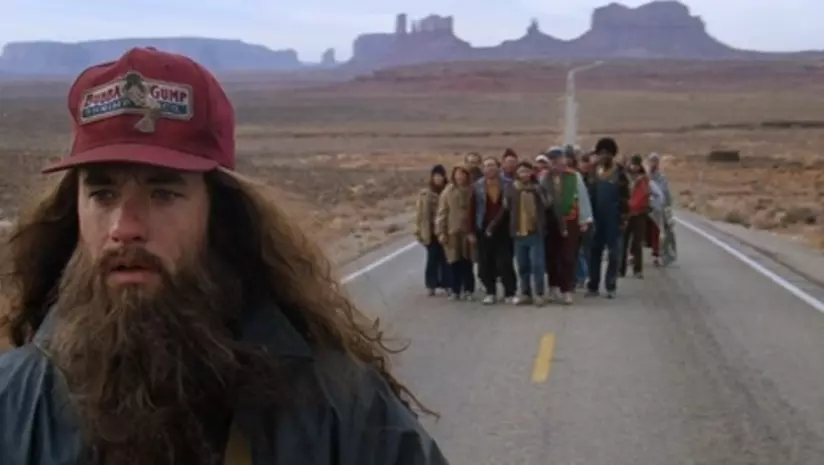
This is super random, but this thought came to me as I was re-reading “Song of the Open Road”. It honestly reminds me a lot of Forrest Gump (W movie, if you haven’t seen it, you should). Bear with me on this one. While the story is about a lot more than just running, it’s kind of Forrest’s primary thing he’s known for. He leaves everything and spends 3 years running across the country for no reason, with no destination in mind. He’s just running. Remind you of anything? Perhaps Whitman’s own journey on the open road to find himself? Whitman invites everyone to join him on his travels, encouraging them to drop everything, and take to the road much like Forrest, though Forrest does so unintentionally. This scene in particular makes me think of Whitman leading the people on his “long brown path”.

Obviously, there are many differences between the two men, considering Forrest Gump has an IQ of 75 and Whitman is, well, Whitman, but I thought it was a fun comparison and wanted to share. If you’re interested to see the part of the movie I’m referencing, I’ll put a youtube link below!

Forrest Gump runs across America for 1170 days and 16 hours