
Bailey’s CS for March 17

In our readings for today, I was particularly interested in Dickinson’s letter to Higginson on April 25, 1862 (#261). There are a lot of interesting mysteries within. She mentions “I had a terror – since September – I could tell to none” and then later in the letter seems to emphasize this secret trauma by saying, “They are better than Beings – because they know – but do not tell.”

Famously, some scholars theorize that Emily Dickinson’s most prolific years of poetry came about due to some possible trauma (which also could have influenced her progressive isolation). But I’m curious why she would have so cryptically mentioned it here and nowhere else? Perhaps she felt safe in some way because Higginson did not yet have a personal relationship/rapport with her? Or perhaps she was simply explaining the source of her muse to a fellow literary-minded person who might best understand?

Or maybe there is a way to read this letter as Emily Dickinson sort of putting on airs? Although she doesn’t express a desire for getting published, when I read this letter, it does feel a bit like she is seeking some sort of poetic validation as she asks for Higginson’s mentorship. There are several lines which I feel she wrote purposefully to play into Higginson’s potential ego or masculinity – “I went to school – but in your manner of the phrase – had no education,” “But I fear my story fatigues you,” and, of course, her infamous comment on Whitman.

To me, this all reads very sly and coy. Emily Dickinson is so incredibly smart and she’s almost downplaying that on purpose here in order to seek Higginson’s mentorship. It makes me wonder what her true feelings on Whitman are, because to me, it seems like she’s only saying that she was “told that he was disgraceful” because it could possibly align with what Higginson believes.

I’m interested to know what other people think of these mysteries. Is Dickinson being authentic here? Or is she intentionally playing a part? If she doesn’t want to be published, what is she looking for? Validation or true tutorship?
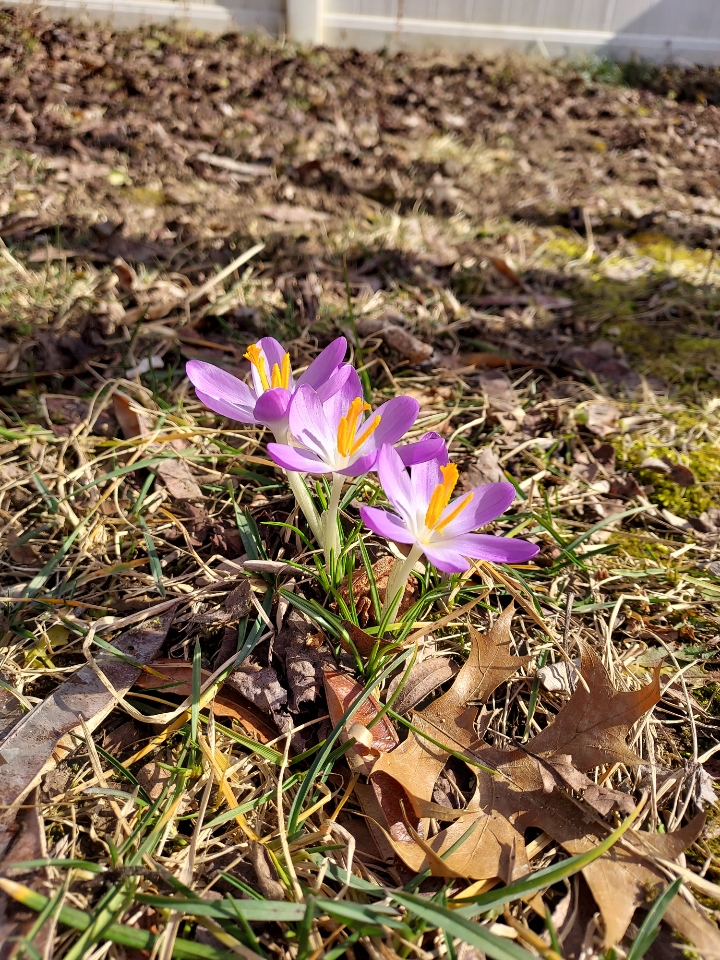
Ever-Returning Spring

Today, this little purple crocus appeared in our backyard. Our first flower of Spring!

It’s not a lilac per se, but the fact that it appeared today on the day we discussed that particular poem feels meaningful to me. It’s like a little “hello” from the Whitman beyond, so naturally I wanted to share with you all.

Whitman and Women: Take 2

This is my February 10th work! That said, I originally wrote this post blasting Whitman for his portrayal of women and the way he seems unable to separate them from being the vessels of life, as it were. But upon further thought, I’ve changed my mind entirely. So I deleted and I’m reposting. I’m allowed to contradict myself. I contain multitudes.

From what I gathered from Murison’s essay, she discusses the 1800s pearl-clutching in reaction to Whitman’s treatment of sexuality. Particularly his treatment of women’s sexuality, as modesty and privacy were integral to society’s definition of white women’s sexuality (which was inseparable from the heteronormative institution of marriage). Whitman, therefore, was lewd in discussing unmarried women as sexual beings. Intimacy is institutional.

Initially, I felt like Whitman played into this a bit. I focused on excerpts from “I Sing the Body Electric” where he describes women’s bodies in relation to motherhood and desire, while men were allowed to contain all the knowledge of the universe (see this post which covers what I’m talking about).

But I wanted to squash that initial reaction and give Whitman some grace. Like, alright, what was everyone else at the time writing about?

And I’ve decided that Whitman is radical in acknowledging that women have bodies at all. Bodies they should celebrate and “be not ashamed” of. In “A Woman Waits for Me,” he says:

“Without shame the man I like knows and avows the deliciousness of his sex,
Without shame the woman I like knows and avows hers.”

This right here is the open agency Whitman gives women. Whitman, in his Whitman way, throws modesty out the window. Men don’t need it, but neither do women, and that is definitely radical.