In “I Sing the Body Electric”, Whitman describes the human body, both the female and male bodies, describing their different parts and what makes them sacred and divine. In Section 9, Whitman lists of basically every part of the body, emphasizing this distinction between the body and the soul. And yet, he ends the poem with the line “O I say now these are the soul!” (Whitman 258). So which is it? Are the body and the soul two distinct features of human existence that work together to function within human life, or are these two features interconnected to an extreme degree where they are undistinguishable from each other?
Tag Archives: whitmaniacs
Sarah’s CS for February 5th
Hi all! In stark contrast to the other works of Whitman that we have read and focused on so far, the Calamus poems allow us to take a deep breath after engaging in Whitman’s long-winded and rambling nature, and instead take a dive into his homosexual side.
As mentioned above, the Calamus poems, a collection of 39 relatively, at least by Whitman’s standards, short poems, explore a variety of themes. This is drastically different than the type of long-form writing we have seen from Whitman in “Song of Myself” and “Song of the Open Road”. What does this difference signify? How did this shorter form affect your reading and understanding of the works? Did you feel as though there was an overarching theme found amongst most, if not all, of the poems, or did each poem feel distinct and separated from the others?
One theme that I noticed developing, especially as I continued further into the collection, was the idea of homosexual love, specifically between two men. In the first few poems, such as “Whoever You Are Holding Me Now in Hand”, Whitman’s description of a romantic and/or sexual connection between two men (one of those men presumably being himself) feels more obscure and almost hidden: “With the comrade’s long-dwelling kiss or the new husband’s kiss, / For I am the new husband and I am the comrade” (Whitman 271). To some, this may feel obvious, but compared to the ways that Whitman describes this relationship in poems further within the collection, such as the line “And when I thought how my dear friend my lover was on his way coming, O then I was happy,” (Whitman 276) from “When I Heard at the Close of the Day”, the first quote feels less public and more shied away. Why do you feel that Whitman’s descriptions of homosexual relationships, both romantic and sexual, became more clear and obvious as he gets further into the collection? Is he becoming more comfortable with himself or does he feel that he needs to speak out about this love and desire because he is growing old and running out of time to say it?
Throughout all of these poems, Whitman describes and labels homosexual love and desire, and people who engage in those types of love and desire, different things. For example, in some poems, such as “For You O Democracy” and “The Base of All Metaphysics”, he refers to men who are involved in these relationships as comrades, while in other poems, such as “Are You the New Person Drawn toward Me?” and “City of Orgies”, he refers to them as lovers. Do you see these terms as interchangeable, or is there a distinction between when someone is a comrade versus when they are a lover? In “O You Whom I Often and Silently Come”, Whitman seems to hint at the idea of an unrequited love in the line “Little you know the subtle electric fire that for your sake is playing within me” (Whitman 286); is comrade used when someone does not reciprocate the feelings Whitman has for them, and is lover used when those feelings are returned?
There are so many more questions I could ask, and so many other things I could talk about when it comes to this collection of poems, but I will leave it there for now! Please let me know what you think about any of the things that I mentioned above, or anything else you noticed in this collection of poems; I have a whole list of other things I would love to talk about in regards to them 🙂

The ethics of representation
As promised in class, I am opening this topic for discussion since we didn’t get to it today. I think there are many ways that this connects to (but is not the same as) Whitman’s model of selfhood, which some of you may be writing about through the prompt in Response #1. The basic question might be phrased something like this: when Whitman represents, includes, or speaks for others, does he do so ethically and in a way that respects their otherness from him (in identity and experience)? I think we also want to think through what might be our contemporary understanding of that question as well as what it might have meant in his own historical moment.
A few passages in which we might ground discussion. Feel free to add more.
Section 24, page 211, the two stanzas beginning “Through me many long dumb voices”
Section 33 following the long catalog, starting page 224 with “I am a free companion” and continuing through the rest of section on 226.
Which is the Better “Song of Myself”?
When reading the Deathbed version of “Song of Myself”, I kept thinking back to the first version that we read. Specifically, I kept trying to find what the differences between the two versions were, and what the significance of those differences is. The main thing that stuck out to me, as I’m sure it did to most other people, was the inclusion of section breaks. We have seen sections in other of Whitman’s writing, such as “Leaves of Grass”, but we did not have them in the first version of “Song of Myself” that we read. Last class, we talked about how the pacing and flow of “Song of Myself” (due to a minimal use of periods and instead a constant use of commas) lead us to feel like we are always moving forwards, unable to stop and sometimes unable to breathe. I felt as though the usage of separate sections slowed down this pacing and made the act of reading more manageable, but also less unique and interesting. What did you think of the usage of sections? Do you feel that it helped or hindered the reading experience? What do you think the intention was behind separating the poem into sections?
Aaliyah’s CS for January 27
Snow and Whitman, what more can we ask?
We’ve read two versions of “Song of Myself,” and I instantly noticed a different tone in the 1891-92 version. These lines from the opening section were seemingly added in:Â
My tongue, every atom of my blood, form’d from this soil, this air
Born here of parents born here from parents the same,
I, now thirty-seven years old in perfect health begin,
Hoping to cease not till death. (lines 6-9)
Here, it seems to be an older Whitman reflecting on his past self. There’s almost this conclusion that this poem started in 1855, and, although he’s about to die, this conversation existed before and will continue after him.
Because we are aware of his life story and the context he lived in, our reading is inherently altered. When I first read these lines, it set a tone of death and intrinsic sadness to the entire poem as I knew Whitman was revising this on his literal death bed.
But do you have any other interpretations of how this first section functions as a “prelude” to the rest of the poem? How did you feel initially reading this? Does this say anything about the process of a writer?
A contributor to this sadder tone is the lack of ellipses and his demure use of exclamation marks. In our class on January 22, we discussed his use of punctuation in the 1855 version, and how the ellipses provide space for both the speaker/Whitman and the reader to contemplate his points. In the “death bed” edition, Whitman omits ellipses, giving a definitive and serious voice. Part of me believes this has to do with his age and gained maturity (as a person and writer) but also because of the change in broader America. Whitman initially wrote “Song of Myself” before the Civil War, and, in this final version, the country was dealing with the effects of reconstruction and the promises of the 20th century.
Are there different ways the tone is being depicted other than punctuation? Any other parts where the tone seems extremely precise, even morbid? How do you think his experiences as a nurse contributed to his more certain tone? Are there specific parts which document America’s change?
Enjoy the snow and stay safe!
Aaliyah
Walt Witness
Just wanted to drop in a quote said by Yusef Komunyakaa from in an interview back in 2013 (thank you, Dr. Scanlon)!
I think that what happened is that Whitman gave me a deeper hearing, which may be in concert with a deeper singing. Because I think it’s all about listening. And sometimes if we have, even accidentally, listened, we can hear an echo of the singing. I don’t think that Whitman really sets out to make sense of the world. However, we participate as listeners and readers, to make sense of Whitman. And in that sense, we are making sense of Whitman’s world. Maybe what’s most constructive, for me, is to continue to believe that there’s mystery. Whitman I think taught me to accept mystery. Everything doesn’t have to be explained. Everything doesn’t have to equal a neat number. But there is this immense mystery.
This made me think about our class today, the idea of witnessing (which Komunyakaa discusses more, especially in regards to Whitman and race), and how the act of witnessing can be a song in itself. To witness means to see, to conversate, to repeat, to answer, to reflect—all of which Whitman/the speaker and the reader are required to do in “Song of Myself.” We echo each other in both concrete and ambiguous ways.
Aaliyah
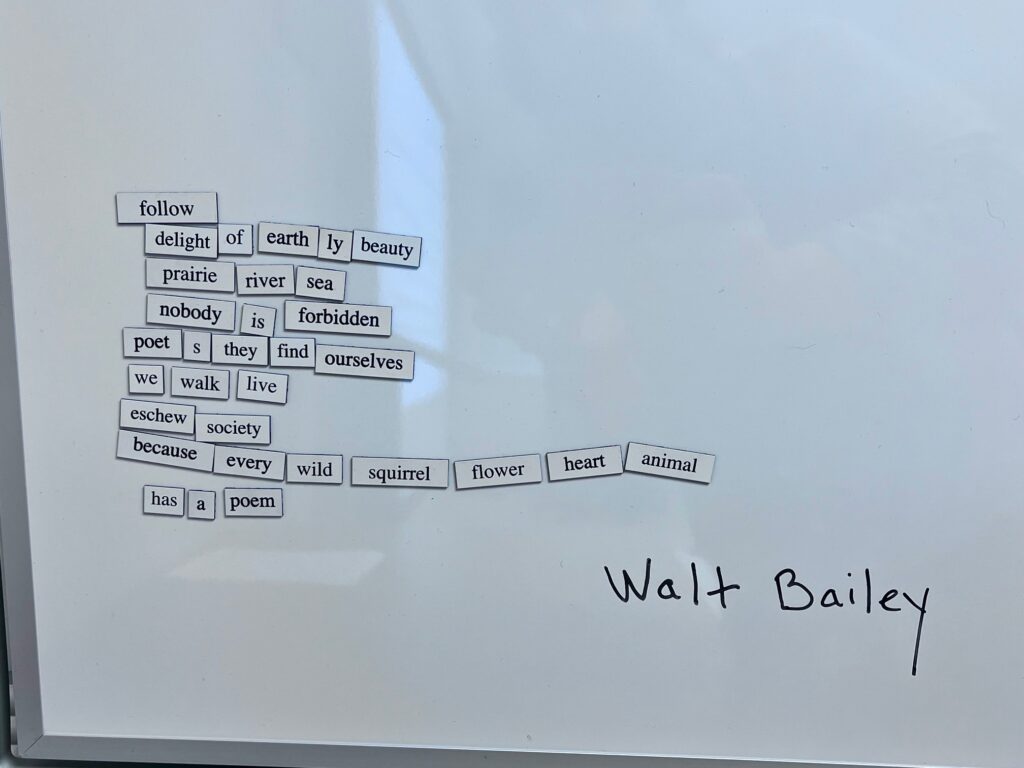
Magnetic Poetry Season Opener

Walt Whitman and Andy Wier
Throughout the trek that is reading “I celebrate myself”, its themes kept reminding me of the short story “The Egg” by Andy Weir.
https://www.galactanet.com/oneoff/theegg_mod.html
Something something “I am the universe and I am everyone and everything, and everyone and everything is me, and consciousness and existence are both plural and ultimately singular, and someday I (and by I, I mean everyone) will reach apotheosis…” I would articulate my thoughts on the connection between these two works more, but I am very tired.
Also… what drugs was Walt Whitman taking in 1855???? I have never read a poem that is simultaneously so horny and so esoteric.
I absolutely cannot with this poem…
Nothing academic to add I just think it’s really important everyone know this was my exact reaction when Whitman thought it essential to add “the scent of these arm-pits is aroma finer than prayer” to his poem:


Who are we talking to? And who are we?
When reading for class tomorrow, all I kept thinking was “who is the ‘I’ that is narrating the poem?” and “who are the ‘you’ that is being talked to?”. I naturally assumed that the narrator is supposed to be Whitman and we are supposed to be the person spoken to, but I always like to think about if that was necessarily the intention of the author. I don’t necessarily have any specific ideas of who the narrator/reader would be if not Whitman and ourselves, but I wonder if the main ideas of the poem would be more impactful if these people were represented by someone else than who we naturally assume them to be.