Run Forrest Run *in Alabama accent*

This is super random, but this thought came to me as I was re-reading “Song of the Open Road”. It honestly reminds me a lot of Forrest Gump (W movie, if you haven’t seen it, you should). Bear with me on this one. While the story is about a lot more than just running, it’s kind of Forrest’s primary thing he’s known for. He leaves everything and spends 3 years running across the country for no reason, with no destination in mind. He’s just running. Remind you of anything? Perhaps Whitman’s own journey on the open road to find himself? Whitman invites everyone to join him on his travels, encouraging them to drop everything, and take to the road much like Forrest, though Forrest does so unintentionally. This scene in particular makes me think of Whitman leading the people on his “long brown path”.
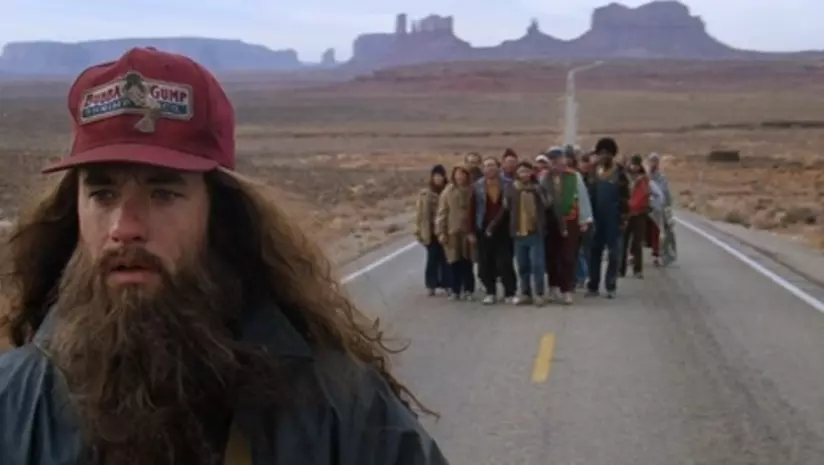
Obviously, there are many differences between the two men, considering Forrest Gump has an IQ of 75 and Whitman is, well, Whitman, but I thought it was a fun comparison and wanted to share. If you’re interested to see the part of the movie I’m referencing, I’ll put a youtube link below!

Forrest Gump runs across America for 1170 days and 16 hours

Camerado

At the end of class we were discussing what Whitman meant by the address “Camerado” at the end of his poem Song of the Open Road. This word felt like a reward of sorts. I say reward in relation to the readers of the the poem, “Camerado” feels like a compliment to those who have finished reading Song of the Open Road-they are now considered comrades. With these comrades, Whitman holds out his hand to allow those to join him in finding wonder/beauty in everything.

Reviews of “LoG”

When doing the readings for today’s class, I was very interested by the completely opposite reactions to Whitman’s “Leaves of Grass” expressed in the two reviews of it. While I don’t think the fact that this work was controversial and lead to such different views of the work is surprising, it was very interesting to me to see how differently the reviews were written. I feel like the way that they were written directly reflects the views that the reviewer had on the work.

The negative review, written by Rufus W. Griswold, is what you would expect of a traditional review/comment on a work. It briefly describes the type of things the work talks about (even if it is done so in a very biased way), and then goes into the reviewers opinion of the work. Griswold discusses how the views of Whitman go against social virtues, and therefore should not be read or distributed by anyone. The standard nature of the review reflects want for society to follow a standard socialized order, abiding by certain moral codes and rules.

In contrast, the positive review, written by Fanny Fern, is not written in a traditional way. It is much more confusing and requires more thought to understand what exactly she is saying about Whitman’s work. Fern is directly expressing her appreciation and positive feelings towards Whitman’s work not just through her actual words, but through her going against of the standard order and format of a review.

Notes from the Grossly Reductive Introduction to Transcendentalism

Hi! I don’t have any crazy thoughts provoking questions or ideas for the blog (at least not yet), but I wasn’t able to be in class week because of a conference I was attending out of town. As I was doing the readings from this past week, as well as reading over the notes a friend (thanks Tanner) sent me from Thursday’s class, I was just wondering what people’s thoughts on transcendentalism, the poets we are studying, and just the general purpose of this course are. What big ideas or important details did you take away from the readings and Thursday’s class?

Based off of the readings, it feels like transcendentalism, and therefore this course and the works we are going to read within it, focus heavily on the idea of humanity and that people’s lives should not be tied to, dependent on, or only fulfilled by conforming to the capitalist society that we live in. To be truly satisfied, we need to have emotion and social connections with one another, which is what WW and ED seem to have used poetry to do; it is a medium through which they can create those connections with others not just for themselves, but for people who read those works and then connect with each other (like us in this course!). I know I’m posting this pretty soon before class tomorrow (sorry Dr. Scanlon…), but any notes or thoughts are super helpful, and I’m excited to actually get to be in class and a part of discussion tomorrow!