When doing our readings for tomorrow, this poem specifically struck me due to its social commentary on the expectation of women during this time period. When girls, (more often than not very young girls), were married off, they immediately became “women” and were expected to adhere to their societal “duties.” Dickinson mentions how “odd the Girl’s life looks” (2.5) being forced to mold herself into this “woman” that is deemed so desirable. This poem is read with a particularly melancholy tone in my opinion, almost mourning the loss of innocence and independence of girls of this era, and recognizing that this reality isn’t how it’s meant to be. Dickinson also seems frustrated as she throws in an ironic remark at the end of it, “But Why compare? I’m “Wife”! Stop there!” (2.11-12).
Ella’s CS for 3/26 readings
The selection of poems for 3/26 is a strange yet somehow comprehensive mix. They touch on classic Dickinson themes like death, nature, and religion, but what stood out to me was how frequently she writes about housewives and marriage. We know where Dickinson stood on the topic: she was a proud spinster and generally opposed the concept of marriage (a real feminist). I think it’s easy to see in some of these poems just how passionate she was about the subject. Some of her characteristic humor and sarcasm even come through at times in her satire (I’m specifically thinking of 267). How do you interpret Dickinson’s poems about marriage? What can we infer about her views on gender roles from her writing? What do you think prompted Dickinson to have this view of housewifery?
The poems I’m thinking of when writing this are 185, 194, 225, 267, and 280. Are there other poems from this collection of readings or others we’ve previously read that you think relate back to this theme? Are there any that you interpret as having a positive outlook on marriage? What do you think Dickinson would think of LGBTQ marriage rights? Do you think she’d be less critical of queer marriages?
This conversation starter wouldn’t be complete without mentioning poem 269, “Wild nights – Wild nights!” (ironic it’s 269), because there’s definitely conversation to be had. Dickinson has a number of erotic poems; however, this is one of the most renowned. We discussed poem 121 in class today and noted the use of the metaphor “Her breast is fit for pearls, / But I was not a ‘Diver.'” Wild Nights also makes use of nautical metaphors such as “Might I but moor – tonight – / In thee!” What do you think of this common theme? Why do you think Dickinson relates sexuality to the ocean and things associated with it? At the time, this poem would have been widely disputed due to its sexual nature, especially considering the religious context. There are interpretations of this poem that argue that the speaker’s passion and love are for God and that “Wild nights” refers to moments of spirituality, but I struggle to see that perspective, given what we know about Dickinson’s relationship with religion. Who do you think the poem is addressing? Do you agree more with the sexual interpretation or the spiritual? Why?
There are so many poems in this selection that I love, and I wish I could speak on them all, but alas I only have so much space, so I leave you with this…if “‘Hope’ is the thing with feathers – / That perches in the soul” and Emily is “a sparrow” who builds her “perennial nest” in Sue’s heart, does that make Dickinson the personification of hope? (assuming the soul and the heart are one and the same) Who’s to say? Only Dickinson knows what she meant; she was far too smart for the rest of us.
Mohammad’s CS For March 26th
One thing that’s stood out to me across Dickinson’s poems is how much they seem to rely on suggestion rather than full description, giving us fragments of a scene that feel capable of expanding far beyond what is actually written. A few symbolic markers appear, their relationships remain only partially defined, and the poem seems to hover in the space between them rather than fully spelling itself out. Reading Dickinson feels less like moving through a completely rendered landscape and more like encountering a moment in outline, where the scene gradually takes shape as the reader begins to fill in what has been left unstated. This introduces a kind of paradox. If Dickinson’s writing is so fragmented and limited in detail, how is it still able to function and build a coherent scene that feels widely recognizable rather than purely personal? If the reader is supplying much of the texture and imagery, then in theory everyone should be imagining something different, yet Dickinson’s poems still seem to produce a shared sense of situation and meaning.
One poem that seems to highlight this especially well is:
“Mute – thy coronation –
Meek – my Vive le roi,
Fold a tiny courtier
In thine ermine, Sir,
There to rest revering
Till the pageant by,
I can murmur broken,
Master, It was I -”
Even in just a few lines, Dickinson establishes the structure of a royal ceremony through a handful of symbolic elements: a coronation, a courtier, an ermine robe, and a passing pageant. The poem never actually describes the ceremony itself, yet the hierarchy and atmosphere of the moment still come into view. We do not see the crowd, the throne, or even the figure being crowned, but those details feel implied by the framework Dickinson provides. The opening phrase, “Mute – thy coronation -,” situates the reader within a moment of public significance, while the speaker’s silence suggests a private position within that larger event. The “tiny courtier” further defines this relationship, placing the speaker inside the ceremonial structure without giving them a visible role in it, and the reference to “ermine” evokes royal imagery without ever specifying the figure wearing it. By the time the “pageant” passes, the scene has taken shape almost entirely through implication, with the speaker only quietly revealing themselves afterward in “Master, It was I.”
One way this begins to make sense is that Dickinson’s poems seem to operate less through depiction and more through activation, where the poem provides the structural conditions for a scene and the reader’s imagination brings that scene into experience. The language establishes orientation, hierarchy, and emotional tone, but stops short of filling in visual and narrative detail, leaving space for the reader to extend what has been suggested. Because those suggestions are anchored in shared symbols such as coronation, courtier, and pageant, the reader’s additions remain guided rather than arbitrary, allowing the scene to feel coherent across different readings. At the same time, this creates a tension. If the reader is responsible for activating the scene, then meaning begins to depend on individual imagination, yet Dickinson’s poems still seem to produce a recognizable shared structure rather than completely divergent interpretations. The poem holds together two competing impulses: openness that invites participation, and constraint that preserves coherence. The reader helps bring the scene into experience, but the poem still shapes the limits of what can be imagined.
What Dickinson’s poetry ultimately makes visible is a more unstable and collaborative understanding of poetic form. If a poem can achieve completion while leaving so much of its image, texture, and even wording structurally open, can its existence really be reduced to the language materially present on the page? If the poem takes shape in the interval between inscription and imagination, between the writer’s fragment and the reader’s activation of it, what does that suggest about where the poem actually resides? If the poem does not need to fully render the scene it invokes, and can instead rely on symbolic structures, partial images, and withheld description to produce a powerful aesthetic experience, does the boundary between author and reader begin to blur? When the reader is no longer simply receiving the poem but participating in its imaginative realization, how much of a poem must actually be written for it to exist as a poem at all? And if a poem depends so heavily on the reader’s imagination, does it remain the expression of a single authorial consciousness, or does it become, in some meaningful sense, a shared construction between the poet who outlines the form and the reader who brings that form into experience?
Gratitude


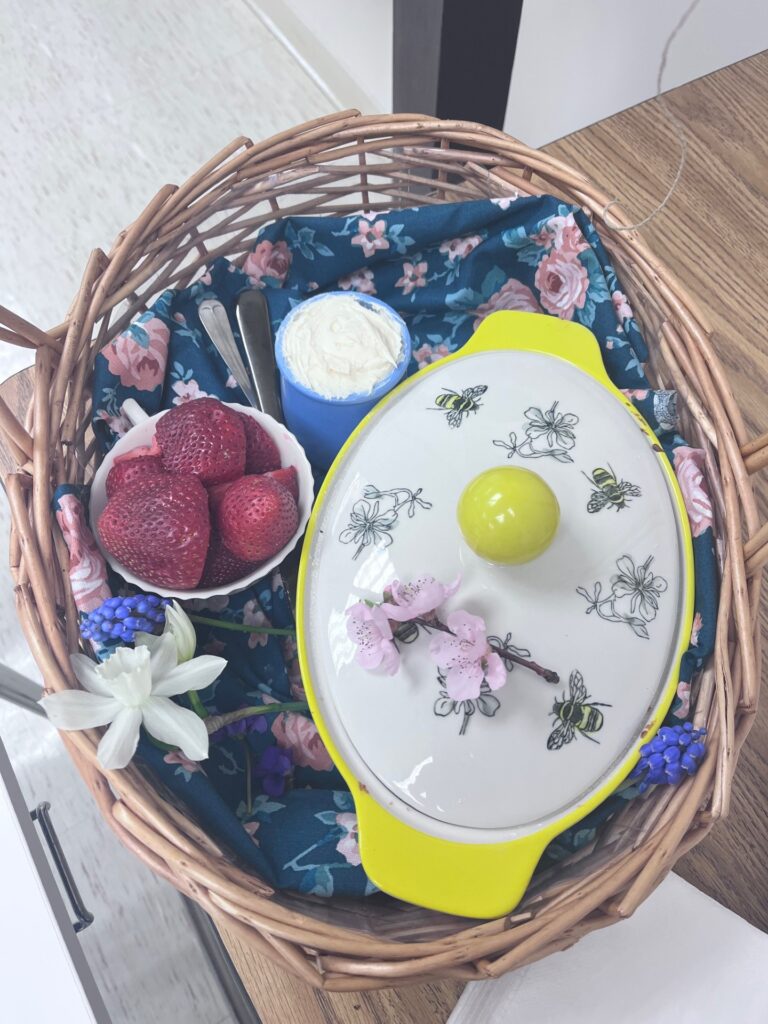
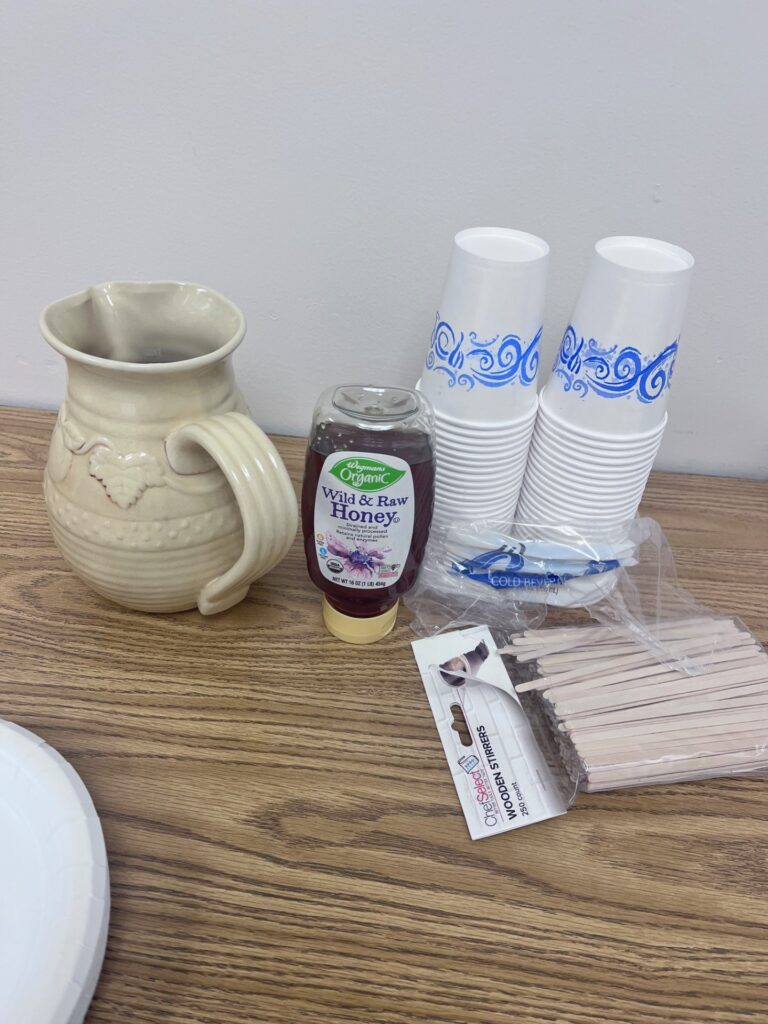
Dickinson saw baked goods as a way to celebrate, to comfort, to provide stability, to reinforce community, to nourish. Thank you, Bailey.
Poem 121, Home, Heaven, and Perennial Nests
I promise I will connect this all…
Much of my Response 4 involved thinking about how ED characterized Death (yes, capital D) in her letters, and how she spoke of Death as a relief/release. She talked of Death as a means to Heaven and how life after Death was the ultimate safe space, the ultimate home. So, since having recently writing my response thinking about this, I had this idea in my mind when reading all of the poems for today.
I found poem 120 very sweet in its suggestion that Heaven can mean anything to anyone–it is neither static nor extravagant but that it is made of simple pleasures.
With both of these ideas top of my mind, I read poem 121 (and most especially, the ending) as ED suggesting that Sue is her Heaven. ED either does not want to or is not able to give Sue the extravagant things in life, but she does not need to. Sue is her home, she is her heaven.
I just love these ladies.
Whitman or Dickinson?
This is a very surface level thought, but it is still so jarring to me to compare the lengthy, 50-page poems we were reading from Whitman to the sometimes only 4-8 line poems from Dickinson. Which do you prefer? As of now, I think I prefer Dickinson because even though her poems are harder to understand, they feel more fun to read (sorry Whitman). Also, Dickinson is a woman, and I’m always going to choose a woman over a man (not sorry Whitman).
Poem #88 – Music
Letter-poem vs. Poem-poem
I don’t know if this is controversial, but I’ve found after reading Emily Dickinson’s poetry in depth for the first time (besides the few poems in school/on Pinterest I’ve read) that I enjoy reading her letters more. Maybe I’ve gotten so used to Whitman’s long lines that I have been indoctrinated into liking longer lines more than short ones. The complex, image dense, and emotional letters make me feel like I’m “touching” Dickinson through the paper (Whitman style). Every word feels like it belongs, like every word was specially chosen after much deliberation. Yet, the words don’t feel forced. It doesn’t feel like the letters are trying too hard, or trying to be something they’re not. They’re also sooo image dense, from start to finish I am fully enthralled. It could also be the mildly taboo nature of reading someone’s personal writings. Who knows!
Algorithm Goddess Sends Me This
Ed Norton and Walt Whitman on Stephen Colbert!
Hi everyone! I don’t know who if anyone here keeps up with late night tv but I thought it would be relevant to share this clip from Stephen Colbert the other night where Ed Norton recites “Crossing Brooklyn Ferry”. I will include the whole video with the interview and performance because I think there is some really great stuff about purposeful action and poetry as a solution for the anxiety that comes from constant stimulation on the internet.