Walt Witness

Just wanted to drop in a quote said by Yusef Komunyakaa from in an interview back in 2013 (thank you, Dr. Scanlon)!

I think that what happened is that Whitman gave me a deeper hearing, which may be in concert with a deeper singing. Because I think it’s all about listening. And sometimes if we have, even accidentally, listened, we can hear an echo of the singing. I don’t think that Whitman really sets out to make sense of the world. However, we participate as listeners and readers, to make sense of Whitman. And in that sense, we are making sense of Whitman’s world. Maybe what’s most constructive, for me, is to continue to believe that there’s mystery. Whitman I think taught me to accept mystery. Everything doesn’t have to be explained. Everything doesn’t have to equal a neat number. But there is this immense mystery.

This made me think about our class today, the idea of witnessing (which Komunyakaa discusses more, especially in regards to Whitman and race), and how the act of witnessing can be a song in itself. To witness means to see, to conversate, to repeat, to answer, to reflect—all of which Whitman/the speaker and the reader are required to do in “Song of Myself.” We echo each other in both concrete and ambiguous ways.

Aaliyah

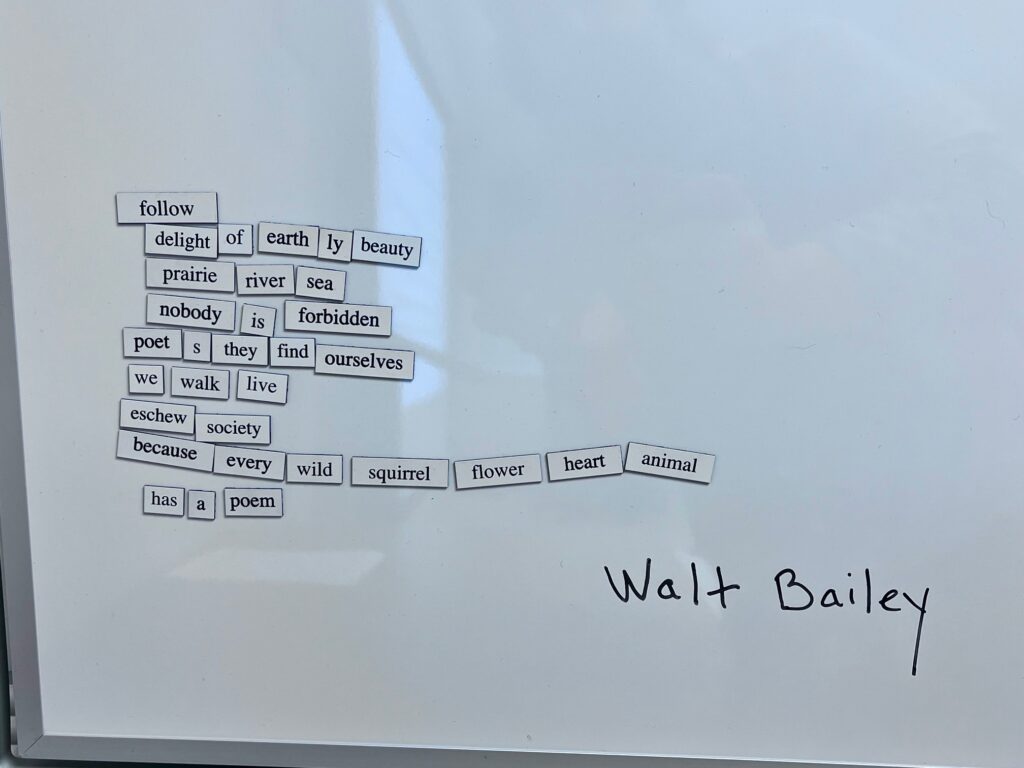
Magnetic Poetry Season Opener

pg. 58 – “They do not sweat…”

While I do agree with the points made in class about Whitman desiring to remember all of the important things in life, things that are simple and honest and good, I also feel a little bit critical of this section. He talks about wanting to be like animals because they are not concerned with productivity and materialism and vanity, which is fair, but he criticizes humans for being sweaty, whiny, religious, materialistic, industrious, and the like without questioning what has made humans that way. I would argue that the negative traits he attaches here to humans (and almost, to human nature) are not inherent to humans but rather imposed on them by society, the government, the social contract, etc. I do not feel that it is completely fair of him to desire to be more like animals because he wants to be less like humans, especially since he spends so much time focusing on the beauty and strength in individuals. It makes sense that he would want to get away from these things, but I think the passage could be strengthened by a criticism of, say, ideological state apparatuses.

Walt Whitman and Andy Wier

Throughout the trek that is reading “I celebrate myself”, its themes kept reminding me of the short story “The Egg” by Andy Weir.

https://www.galactanet.com/oneoff/theegg_mod.html

Something something “I am the universe and I am everyone and everything, and everyone and everything is me, and consciousness and existence are both plural and ultimately singular, and someday I (and by I, I mean everyone) will reach apotheosis…” I would articulate my thoughts on the connection between these two works more, but I am very tired.

Also… what drugs was Walt Whitman taking in 1855???? I have never read a poem that is simultaneously so horny and so esoteric.

Who are we talking to? And who are we?

When reading for class tomorrow, all I kept thinking was “who is the ‘I’ that is narrating the poem?” and “who are the ‘you’ that is being talked to?”. I naturally assumed that the narrator is supposed to be Whitman and we are supposed to be the person spoken to, but I always like to think about if that was necessarily the intention of the author. I don’t necessarily have any specific ideas of who the narrator/reader would be if not Whitman and ourselves, but I wonder if the main ideas of the poem would be more impactful if these people were represented by someone else than who we naturally assume them to be.

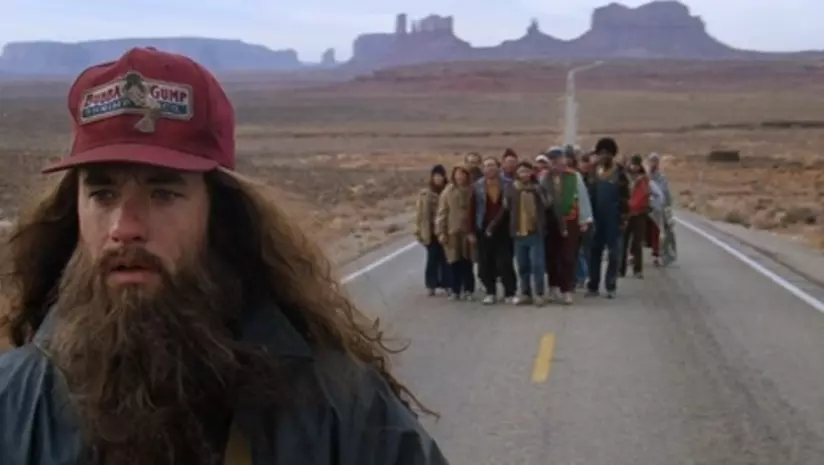
Run Forrest Run *in Alabama accent*

This is super random, but this thought came to me as I was re-reading “Song of the Open Road”. It honestly reminds me a lot of Forrest Gump (W movie, if you haven’t seen it, you should). Bear with me on this one. While the story is about a lot more than just running, it’s kind of Forrest’s primary thing he’s known for. He leaves everything and spends 3 years running across the country for no reason, with no destination in mind. He’s just running. Remind you of anything? Perhaps Whitman’s own journey on the open road to find himself? Whitman invites everyone to join him on his travels, encouraging them to drop everything, and take to the road much like Forrest, though Forrest does so unintentionally. This scene in particular makes me think of Whitman leading the people on his “long brown path”.

Obviously, there are many differences between the two men, considering Forrest Gump has an IQ of 75 and Whitman is, well, Whitman, but I thought it was a fun comparison and wanted to share. If you’re interested to see the part of the movie I’m referencing, I’ll put a youtube link below!

Forrest Gump runs across America for 1170 days and 16 hours

Gracie’s CS for Jan. 22

Hi everyone! I’m so excited to see how you all feel about this poem! As someone who had never even heard his name before this class, I am finding myself more and more intrigued by Walt Whitman. I tend to be suspicious of male writers who are prone to excessiveness (sorry, not sorry), but I have enjoyed everything from him so far. Anyways, on to the discussion!

One thing that Whitman does well is his portrayal of cosmic forces, nature, and life as giants, and then he immediately zooms in, almost like a fourth wall break to the reader. Why do you think he does this? Does it threaten to take the reader out of the headspace of the poem or, instead, insert them further into the poem? One example of this is in stanza eight (I believe) when, after a few lines about fields and hillsides and reckoning with the earth and then says “Have you felt so proud to get at the meaning of poems?” I imagine this as a gotcha moment for the reader. He does this often with his habit of listing things, often without any connections to eachother. For me, it seems like he is trying to make it easier to conceptualize the feeling or message he is conveying. He is describing these large concepts that we readers might not experience in the day-to-day, and by putting them into more common practises, like understanding a poem finally, we can kind of figure out the puzzle.

Towards the end of the poem, Whitman writes a large section about religion, starting with “My faith is the greatest of faiths and the least of faiths.” He describes participating in multiple forms of worship and devotion to different gods and deities and religious texts. This sort of goes along with the discussion towards the end of class on Tuesday about the semi-Christian tone some of us heard in the last poem. However, this time it is much less covert and not exclusively Christian. Whitman is claiming all of these identities, which leads me to believe that the “me” and “I” in the poem is Whitman taking on the identity of the entire world, or at least attempting to. I would like to know how everyone else understood that specific section.

Thanks for reading! I’m so excited to talk in class about all of this.

Audrey’s CS for January 22

Hi there! If you are reading this, then you must have completed the task of reading Whitman’s longest poem. Congratulations! And if you haven’t read it, feel free to use these questions or thoughts to brainstorm as you read and return to share your own thoughts or responses. 

The title, “I Celebrate Myself” initially comes off as a pretty obvious topic for what the poem is going to be about. I could recall thinking, “how much does this guy have to say about himself that he keeps going for over 40 pages?” However, I was quickly surprised by how much love for both the unknown and the outside world was focused on. Any insecurities he could feel due to his lack of knowledge are romanticized as something to be thoughtful about.  

This began my first true (relevant) questioning about the content of the piece. Does the “I” and “myself” in the title actually refer to Whitman as an individual, or does it represent something else? How could this connect to the previously discussed idea of Whitman being the voice of the people or a representative for America?  

We discussed how Whitman was known for being a voice of the American people. Yet this piece seems to expand to an even broader idea through lines such as “One of the great nation, the nation of many nations—the smallest the same and the largest the same…” (page 23 of the digital archive). Even through short pieces such as “America,” Walt Whitman’s love for the country is evident. However, lines such as these suggest that he has a wider appreciation for nations apart from America. Would he offer his hand as he did in “Song of the Open Road” to someone who wasn’t an American? In this piece, the speaker, perhaps Whitman himself, says “I will not have a single person slighted or left away” (page 25 of the digital archive). 

In a broader sense, do you think Whitman’s statements reflect American patriotism or a more general love for humanity as a whole? Does this connect to the themes Whitman often writes about such as love and nature? Does Whitman seem to value nature as much as if not more than humanity? 

My final statement is another question (surprise!). Do you think this is an ode to Whitman’s love for humanity, self, America, or any other theme; or does this piece have a greater call to action for the reader? The piece ends as the speaker experiences something akin to death (as I interpreted it). There is a sudden influx of ellipses used in this section as if the speaker is slowing down and losing the words to describe what they are. There are now “contradictions” and “barbaric [yawping]” before being “[departed] into air” (page 55/56). We, the readers, or “you” are left with the speaker waiting for “you” after they are gone. Is that truly a celebration of self? Being left to be found with hardly any identity or meaning? 

Thanks for reading all my rambling questions! Obviously since this piece is so long, one can find a different idea to look at every time they read. Even if your thoughts deviate from the questions or thoughts I had, I’d love to hear anything and everything!  

Camerado

At the end of class we were discussing what Whitman meant by the address “Camerado” at the end of his poem Song of the Open Road. This word felt like a reward of sorts. I say reward in relation to the readers of the the poem, “Camerado” feels like a compliment to those who have finished reading Song of the Open Road-they are now considered comrades. With these comrades, Whitman holds out his hand to allow those to join him in finding wonder/beauty in everything.