In Drum-Taps, Whitman makes a few new choices that we have not really seen from him so far. In two of the poems within this collection (“Song of the Banner at Daybreak” and “The Centenarian’s Story”), Whitman separates the poem into sections dictated by the person who seemingly is speaking. This method gives these poems a sort-of story-like feel, which is something we may expect more from prose rather than poetry. Another change that I noticed was in “Dirge for Two Veterans”, in which Whitman both uses much shorter lines than in his other poems and adds an indent to the first and fourth line of each stanza. Why do you think Whitman made these changes? Do you think that they are supposed to represent something, or is merely noticing their difference supposed to mean something in itself?
Category Archives: Uncategorized
Old Men Want WW BAD
Also, something that came to my brain just now is that whenever I mention Walt Whitman to older men (60+), they always hoot and holler about his writings and intellect and it always makes me wonder if they were aware of his raging homosexuality and if they were aware, would they change their minds?
I don’t know, just run-on sentence food for thought.
To Express is Power
This is my February 10th work. 🙂
In these pages, it seems that Whitman is grateful he can have sensations at all. Sensuous acts or simply breathing the same air alongside another makes him whole. It’s this wholeness, and ability to satisfy his every waking desire, that provides a sense of control. Human connection drives his every action. How he views others either helps in the short-term for his libido or long-term for the betterment of himself. Though this feels almost carnal and selfish when scrawled in this fashion, it still illuminates how freeing it is to live without worry of the outside world. If Walt Whitman had luscious locks (other than his Santa beard), I’d say this is his way of letting his hair down and welcoming readers to do the same. It is an invitation to leave caution to the wind and express your natural desires; maybe even heighten them. New stigmas present themselves in every era of how someone should carry themselves, dress themselves, aspire to be, but what remains the same throughout history is the desire to be loved and seen.
This could be seen as retroactive, but it was interesting to read about a man being described in a sexual manner and letting the ladies have a breather. Though he did end up going into intense detail about women’s bodies, it was done so after his steamy daydream of masculinity. He then takes the original point and has a field day describing what attracts him so much to men; which leads us back to the idea of blessed expression and how important it is to have an outlet to revel in our healthy sexual desires.
Anyways all this to say, keep the sex poems coming Walt.
Dear Mother
As our reading for tomorrow, and the bio you read pre-Ice Age, said, Whitman traveled to Fredericksburg from NY in 1862 when he saw his brother George Washington Whitman listed among the wounded in the absolutely brutal battle that took place under our feet. (It wasn’t that uncommon for family members to come looking for their wounded and to help care for them; in the US there was no professional nurses’ training until the 1870s.) His brother was only lightly wounded, but Whitman remained across the Rappahannock River in the Union camp for a few weeks, where what he saw inspired his new calling as a “spiritual wound-dresser.” We will read some of his impressions for our second class focused on the war and its aftermath.
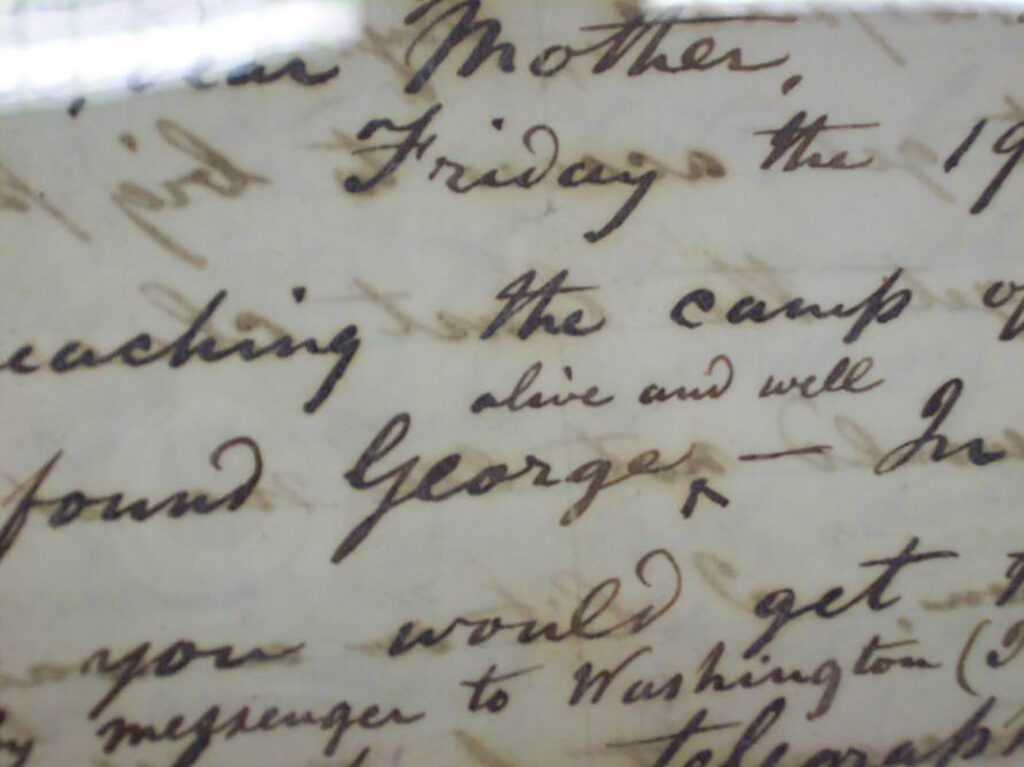
In class last time, as we discussed what it means to speak and write with a specific addressee in mind, I mentioned a letter of Whitman’s that I had seen at the Library of Congress after reading its content many times in print. In this letter, he writes to assure his mother that he has located George. This is my photo:

It’s the caret that breaks me.
Knowing that his mother, the addressee, would be so frantically scanning this letter to find news about her son, he returns to what he has originally written and adds quick words to comfort her. In print, there is no sense that the phrase “alive and well” is an addition, is a marker of dialogic understanding and of a son’s love. Beautiful.
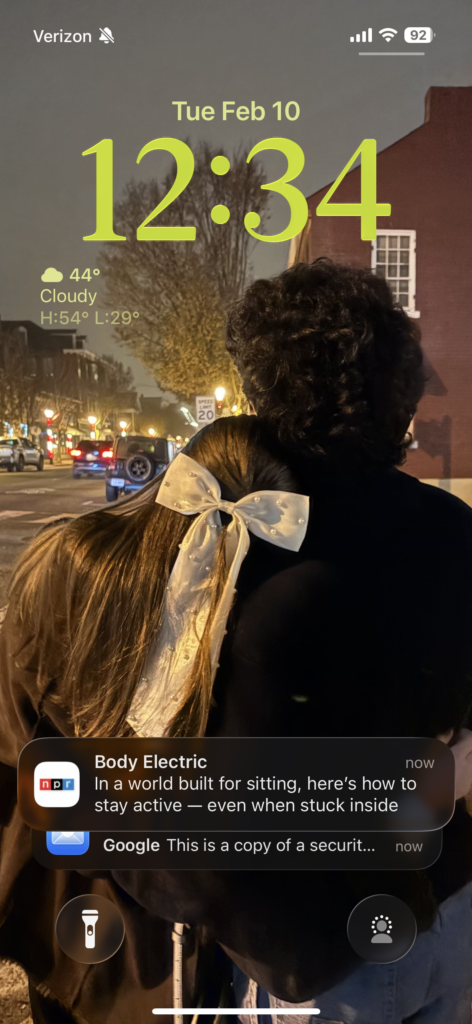
Maybe my phone is listening…maybe Whitman is listening
I got this NPR notification yesterday shortly after our class, and it got me thinking. If he were around today, would Whitman really be encouraging people to get up and work out? I don’t really think so. I think that he would be encouraging us to turn off our phones and think for ourselves instead.

My two favorite things: Whitman and Sex!
This is my February 10th work.
(The title is a joke… obviously.)
I can not, for the life of me, figure out if I like Walt Whitman. I think I have created some image in my head of an egotistical man who thinks he knows everything (imagine Stephan Dedalus). Then I read his poems and actually feel like they are personable and introspective, and then I get confused.
From Pent-Up Aching Rivers is one of the poems that really intrigues me when it comes to Walt. In my caricature of him, Walt is a 1800s f-boy, for lack of a better term. This poem praises not only sex for pleasure but also, in the beginning, sex for procreation. When describing love, he uses imagery of waves, rain, birds, smells of nature, etc. He uses the words flesh and divine in the same line, his view of sex bouncing back and forth between something extremely human and real and something otherworldly. We have seen this literary tactic used multiple times within his writing, where he will jump from the grandiose to the everyday. I am also fascinated by his beautiful descriptions of women and their love as a gay man. It makes me appreciate his talent for writing from the viewpoint of all different people.
This was a very scattered brain, but I really loved this poem and the delicacy and realism he used while writing about sex, and slowly but surely I fear I’m beginning to love Whitman.
Whitman and Women: Take 2
This is my February 10th work! That said, I originally wrote this post blasting Whitman for his portrayal of women and the way he seems unable to separate them from being the vessels of life, as it were. But upon further thought, I’ve changed my mind entirely. So I deleted and I’m reposting. I’m allowed to contradict myself. I contain multitudes.
From what I gathered from Murison’s essay, she discusses the 1800s pearl-clutching in reaction to Whitman’s treatment of sexuality. Particularly his treatment of women’s sexuality, as modesty and privacy were integral to society’s definition of white women’s sexuality (which was inseparable from the heteronormative institution of marriage). Whitman, therefore, was lewd in discussing unmarried women as sexual beings. Intimacy is institutional.
Initially, I felt like Whitman played into this a bit. I focused on excerpts from “I Sing the Body Electric” where he describes women’s bodies in relation to motherhood and desire, while men were allowed to contain all the knowledge of the universe (see this post which covers what I’m talking about).
But I wanted to squash that initial reaction and give Whitman some grace. Like, alright, what was everyone else at the time writing about?
And I’ve decided that Whitman is radical in acknowledging that women have bodies at all. Bodies they should celebrate and “be not ashamed” of. In “A Woman Waits for Me,” he says:
“Without shame the man I like knows and avows the deliciousness of his sex,
Without shame the woman I like knows and avows hers.”
This right here is the open agency Whitman gives women. Whitman, in his Whitman way, throws modesty out the window. Men don’t need it, but neither do women, and that is definitely radical.
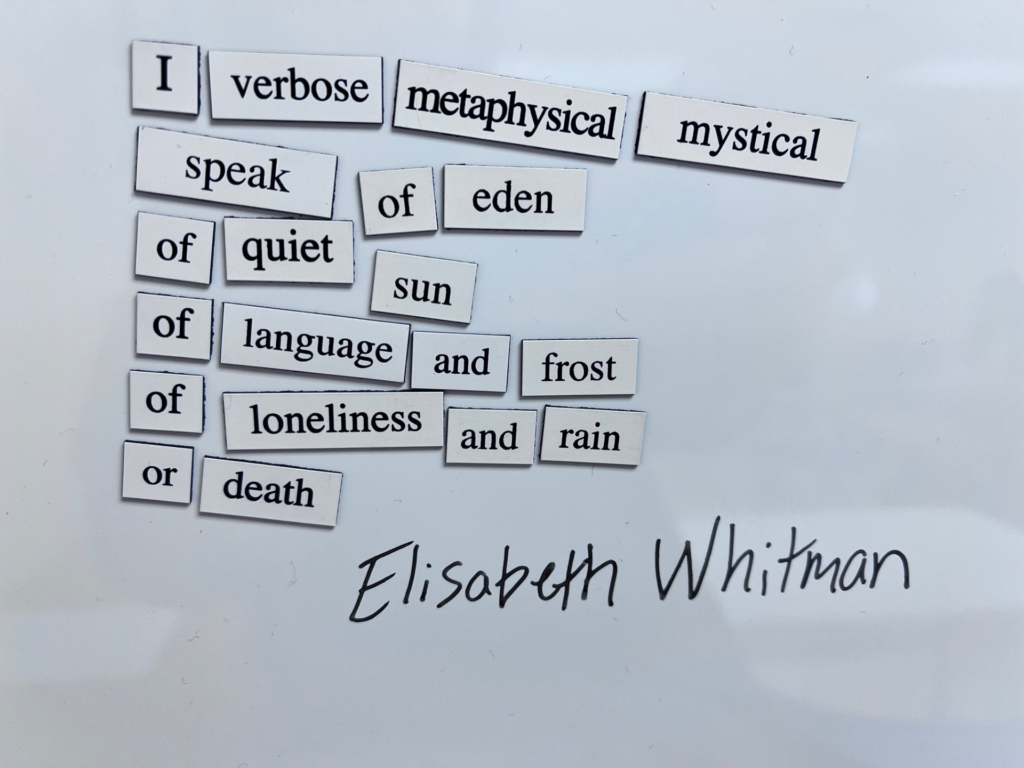
Magnetic Poetry the Second

Conversation starter, feb 12: Drum-taps
IN 1996, the year Felix Gonzalez-Torres died, I made a version of his “Untitled” (Perfect Lovers), 1987–90, by hanging two identical battery-operated clocks side by side on my living-room wall. I had always admired his work, and, like friends who had foil-wrapped candies sitting on their bookshelves or a sheet of paper from one his stacks pinned to their walls, I too wanted to live with a Felix. –Glenn Ligon, “My Felix”
When I first read My Felix, I already had my own Felix hanging for a year and a half. Much of Felix’s work relies on ready-made objects like clocks, or endlessly replenishable piles of materials (candies, prints, papers, etc.) which viewers are encouraged to take home with them, as they interact with his work. Whether we take candy from an art gallery, or hang our own clocks just-so, anyone can have their own Felix—this rides the line between democratic access and entitlement. Felix is all of ours, but Ligon’s Felix is his—my Felix is mine.
When we first discussed a distinction between Walt Whitman and “my Whitman / our Whitman / each’s-own Whitman,” I thought of this essay. Not only because the language is so similar, but because Felix and Walt have instilled the same instinct in those who respond to their work: to claim and construct a personal relationship, beyond the work, with the artist as a force.
Working through the height of the AIDS crisis, and himself HIV positive, Felix’s work is both sharply political and deeply personal. His work encompasses sculpture, printmaking, public installation, viewer participation… it can be hard to tell where any specific Felix piece starts or ends. For example, Untitled (Portrait of Ross in L.A.) is a work of art that consists of “just” a pile of candy placed on the floor. The work is specifically noted as having an “ideal weight” of 175 pounds, the weight of Felix’s partner, Ross Laycock, at the time of his own HIV diagnosis. Viewers are encouraged to take a piece of the candy, which represents the weight loss Ross experienced due to AIDS complications, while making literal the metaphor of the “sweet taste he would leave in your mouth” after meeting him. Does the “artwork” start with the gallery purchasing the candy? Putting it into the pile? With a viewer taking a piece? Does the work end when the candy is eaten or thrown away? Is each wrapper in a landfill still part of the work?
In 2010, Ross was displayed at the National Portrait Gallery exhibition Hide/Seek, along alongside an 1891 portrait of Walt Whitman by Thomas Cowperthwaite Eakins.
In tribute to the response by volunteers and caregivers to the needs of people living with HIV and AIDS in DC, the Washington Metropolitan Area Transit Authority and the DC Commission on the Arts and Humanities collaborated to engrave an excerpt from Walt Whitman’s poem “The Dresser” on the north granite circular entrance to the Dupont Circle Metrorail station. –WMATA Art in Transit, 2007
The exclusion of the last two lines of Wound-dresser by WMATA in its Dupont Circle installation is widely considered to be an overt act of queer erasure.
…Ross 1983 (Many a soldier’s loving arms about this neck have cross’d and rested, / Many a soldier’s kiss dwells on these bearded lips.) 1865 Dupont Circle Metro Station 2007… “Untitled” 1989, Felix Gonzalez-Torres
Untitled, 1989 is the first in a series of text-based works by Felix. Described as portraits, the works were commissioned by collectors or institutions, with “short-phrase year-date” lists of events and objects, ranging in scale from global political moments to indecipherable personal sentiments. These works are mutable; collectors and curators are given the power to change the whole text of the work, adding and removing new dates and phrases at their own discretion with each new installation. For the retrospective Always to Return at Smithsonian’s National Portrait Gallery, curators Charlotte Ickes and Josh T. Franco chose to include the final two lines of Wound-dresser, to (even if temporarily) complete the poem for DC’s public.
In another room of the exhibition, (Portrait of Ross in L.A.) and the Eakins portrait of Whitman were reunited, alongside another work by Felix: Untitled (Leaves of Grass), a string of lights.
Part of my reading to prepare for this conversation starter was supposed to be Michael Moon’s paper Memorial Rags. This work seems to have kicked off an entire sub-genre of Whitman criticism which reframes Drum-taps through perspectives of the AIDS crisis. I first saw it referenced in Russell Ferguson’s Out There: Marginalization and contemporary cultures,a book I got only for a series of photo essays by Felix. Unfortunately, I wasn’t able to source the full Moon paper in time for this post. It’s obvious, though, that the construction of Walt Whitman as a forefather in both the stylistic development of “an American art” and as a figure in “an American queer canon” would suggest evidence of a lineage to follow him. Who gets to follow Walt? So much of his poetry demands that we follow him, that the reader of our time is as present as the reader of his time. As Whitman demands, we touch him through his books, Felix demands we take him, taste him through his:
People don’t realize how strange it is when you make your work, and you put it out to be seen and say, simply, “take me.” –Felix Gonzalez-Torres as quoted in his 1995 monograph by Nancy Spector
Whitman’s depiction of the Civil War throughout drum taps focuses on small interpersonal relationships, moments shared between him and soldiers, both living and dead. Out There summarizes Memorial Rags’s analysis of grief thusly: “Rather than looking beyond [Freud’s] ‘Mourning and Melancholia’ for other possibilities—Moon proposes fetishism, but a fetishism rescued from Freud’s 1927 account by making it a conscious means of extending our homoerotic relations, even with the dead…” Both Felix and Walt demand that we engage with their bodies in some physical way, even after their death. Felix does this through his candy portraits, Walt stresses this at the end of Song of Myself.
To boil this down into more specific discussion questions (although I would also love to talk about this big nebula of connection between Felix and Walt, especially site-specific to DC):
- How does the construction of Whitman as a canonical/spiritual/mythological object affect the construction of a queer lineage or tradition in American art?
- How does homoerotic relation in Drum-taps color Whitman’s own beliefs around death, and the connections fraternal and/or erotic made at the brink of or across opposite sides of death?
- What does it mean to construct a “my Felix”, or a “my Walt”? Is artist-as-force or artist-as-ghost a metaphor? A physical interaction? A spiritual event? Especially for those of us who recreated Whitman’s voice for response 1, how did you view the process of channeling Whitman?
And this threat of what’s call’s hell is little or nothing to me,
and the lure of what’s called heaven is little or nothing to me;
Dear camerado! I confess I have urged you onward with me, and still urge you, without the least idea what is our destination,
Or whether we shall be victorious, or utterly quell’d and defeated.
–As I Lay with My Head in Your Lap Camerado, Walt Whitman
although they were still planning on going to that exotic paradise, it was hard to forget about those images of the night before: all those bodies left by the death squads.
–Fetishism, Felix Gonzalez Torres

Body vs Soul or Body & Soul?
In “I Sing the Body Electric”, Whitman describes the human body, both the female and male bodies, describing their different parts and what makes them sacred and divine. In Section 9, Whitman lists of basically every part of the body, emphasizing this distinction between the body and the soul. And yet, he ends the poem with the line “O I say now these are the soul!” (Whitman 258). So which is it? Are the body and the soul two distinct features of human existence that work together to function within human life, or are these two features interconnected to an extreme degree where they are undistinguishable from each other?